Gilles Deleuze
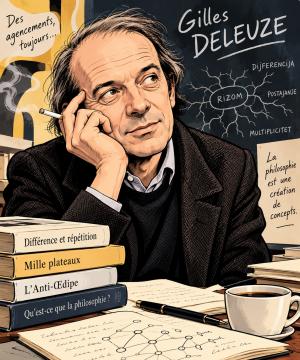
Gilles Deleuze (18. Januar 1925 – 4. November 1995) war ein französischer Philosoph und einer der einflussreichsten Denker der zweiten Hälfte des 20. Jahrhunderts. Geboren in Paris in eine bürgerliche Familie, wuchs er während der NS-Besatzung auf. Sein Vater war Ingenieur und Veteran des Ersten Weltkriegs mit antisemitischen Ansichten. Deleuzes älterer Bruder Georges wurde während der Besatzung wegen seiner Teilnahme am Widerstand verhaftet und starb auf dem Weg nach Auschwitz – ein traumatisches Erlebnis, das den jungen Gilles tief prägte.
Ab 1944 studierte er Philosophie an der Sorbonne, wo er von Hippolite und Canguilhem beeinflusst wurde. Er lehrte an Gymnasien, der Sorbonne in Lyon und ab 1969 an der experimentellen Universität Paris VIII in Vincennes, wo er bis zu seiner Emeritierung 1987 ein beliebter Professor war. 1956 heiratete er Fanny Grandjouan, mit der er zwei Kinder hatte. Er litt an einem schweren Lungenemphysem und beging 1995 Selbstmord durch einen Sprung aus dem Fenster.
Seine Karriere begann er mit Monografien über klassische Philosophen, darunter Studien zu Hume (Empirismus und Subjektivität, 1953), Nietzsche (1962), Kant, Proust, Bergson und Spinoza. Zu seinen wichtigsten eigenständigen Werken zählen Differenz und Wiederholung (1968) und Logik der Bedeutung (1969), in denen er die Ontologie von Differenz, Wiederholung, dem Virtuellen und der Immanenz entwickelt.
1969 lernte er Félix Guattari kennen, mit dem er einige der bedeutendsten Werke des 20. Jahrhunderts schuf: Anti-Ödipus (1972), eine radikale Kritik an Psychoanalyse, Familie und Kapitalismus, und Tausend Plateaus (1980), eine nomadische Ontologie von Rhizomen, Deterritorialisierung und organlosen Körpern. Gemeinsam veröffentlichten sie auch Bücher über Kafka und Was ist Philosophie? (1991).
In seinen späteren Werken beschäftigte er sich mit Kunst – mit Francis Bacon: Die Logik der Empfindung (1981), zwei Büchern über Film („Bild-Bewegung“ und „Bild-Zeit“) sowie Kritik und Klinik (1993).
Deleuzes Philosophie betont Immanenz, rhizomatisches Denken, Werden und Affekte und kritisiert hierarchische Strukturen. Er hat einen tiefgreifenden Einfluss auf den Poststrukturalismus, die Kulturwissenschaften, die Filmtheorie und die politische Philosophie ausgeübt.