Herbert G. Wells
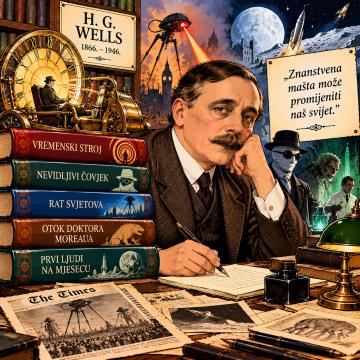
Herbert George Wells (1866–1946), known as H. G. Wells—an English writer, novelist, publicist, and social thinker—was born on September 21, 1866, in Bromley, and died on August 13, 1946, in London. He is considered one of the founders of modern science fiction literature, and his works blend scientific concepts, adventure, and social criticism.
He grew up in a modest family and, thanks to a scholarship, studied natural sciences in London, where he was taught by the biologist Thomas Henry Huxley. His scientific education strongly influenced his creative work and his interest in evolution, technological progress, and the future of humanity.
He achieved literary fame with the novel The Time Machine (1895), in which a journey into the distant future serves as a vehicle for criticizing social inequalities. In the novel The Island of Doctor Moreau (1896), he explores the boundaries of scientific experimentation and human moral responsibility.
These were followed by The Invisible Man (1897)—a story about a scientist whose discovery leads to isolation and violence—and The War of the Worlds (1898), a renowned novel about a Martian invasion of Earth. These works laid the foundation for numerous motifs in modern science fiction. Other notable novels include The First Men in the Moon (1901), The Food of the Gods (1904), Kipps (1905), Tono-Bungay (1909), and The History of Mr. Polly (1910). In these works, Wells expands his focus to include class distinctions, middle-class morality, and the contradictions of industrial society.
He also wrote utopian and historical works, as well as non-fiction. Particularly significant are A Modern Utopia (1905), The Outline of History (1920), and The Shape of Things to Come (1933), in which he examines the possibilities of social development and the dangers of future conflicts.
Wells advocated for education, social reform, international cooperation, and peace, although his political views evolved throughout his life.
His style is characterized by clear storytelling, imaginative scientific premises, and incisive critical thought. Wells has had a lasting impact on world literature, film, and popular culture, and his works continue to raise questions regarding the relationship between science, power, ethics, and the human future.
Titles in our offer

Novi svet: Lik stvari koje dolaze
Wells' vision of the future depicts the collapse of the old world, global wars, and the creation of a new world state based on science, technology, and the planned organization of society. A history of the future with 68 images.

Rat planeta
H.G. Wells's *The War of the Worlds* is a science fiction novel about a Martian invasion of Earth. Superior extraterrestrial invaders cause panic and destruction, and humanity faces a fight for survival.