H. G. Wells
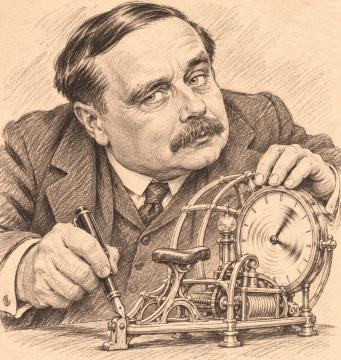
A time traveller arrives in the year 802,701 and finds people who seem to live without a care. Only when he goes underground does he begin to understand what makes their peace possible. In The Time Machine (1895), Herbert George Wells (1866–1946) turns the class divisions of Victorian England into a question about the future of the human species. That premise produced one of the books that shaped modern science fiction.
Wells was born in Bromley, Kent. As a young man he worked as a shop apprentice, studied on a scholarship and taught before devoting himself to writing. He was a novelist, journalist and social critic, and served as president of International PEN between the wars. He died in London.
After The Time Machine came The Island of Doctor Moreau (1896), in which a shipwreck survivor discovers what a scientist is doing to animals far from public scrutiny. In The Invisible Man (1897), a discovery that ought to set a researcher free increasingly cuts him off from other people. In The War of the Worlds (1898), the inhabitants of England suddenly find themselves on the receiving end of conquest when technologically superior Martians arrive. The First Men in the Moon (1901) takes two travellers into an underground world whose inhabitants are divided according to the work they do.
In the social novels Kipps (1905) and Tono-Bungay (1909), Wells can ask similar questions without a trip into the future. A sudden inheritance in the first novel shows how much money can change a person’s standing and how hard it can be to learn the rules of a new social circle. In the second, a cleverly marketed tonic makes a fortune and shows how much that fortune depends on a good story.
Wells’s imagination is clearest in the consequences he draws from a simple premise. An invention opens up a possibility people have dreamed of and then forces them to decide what to do with the power they were so quick to wish for.
Titles in our offer

Novi svet: Lik stvari koje dolaze
Wells' vision of the future depicts the collapse of the old world, global wars, and the creation of a new world state based on science, technology, and the planned organization of society. A history of the future with 68 images.

Rat planeta
H.G. Wells's *The War of the Worlds* is a science fiction novel about a Martian invasion of Earth. Superior extraterrestrial invaders cause panic and destruction, and humanity faces a fight for survival.