Honore de Balzac
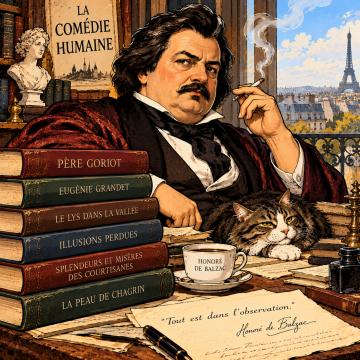
Honoré de Balzac – Bio-bibliography
Honoré de Balzac (Tours, May 20, 1799 – Paris, August 18, 1850) was a French writer and one of the most important figures of European realism. He came from a bourgeois family, studied law in Paris, and briefly worked in law offices, but soon decided to dedicate himself to literature. He published his early novels under pseudonyms and also tried his hand at publishing and printing. Business failures left him with massive debts that plagued him for most of his life.
Balzac was an exceptionally prolific writer, known for his intense work ethic and long nights spent over manuscripts fueled by copious amounts of coffee. His literary ambition was to create a comprehensive portrait of French society in the first half of the 19th century. He linked the majority of his novels and short stories into a monumental cycle titled The Human Comedy (La Comédie humaine), conceived as a kind of literary anatomy of society.
His works feature characters from almost every social stratum—aristocrats, bankers, merchants, civil servants, artists, students, criminals, and the urban poor. A distinctive feature of his literary world is the use of recurring characters across different novels, thereby transforming individual works into parts of a vast, interconnected whole. Among Balzac's most famous works are Father Goriot (1835), Eugénie Grandet (1833), Lost Illusions (1837–1843), Cousin Bette (1846), Cousin Pons (1847), The Splendors and Miseries of Courtesans, The Magic Skin (1831), and The Lily of the Valley (1836). His novels particularly explore the power of money, social advancement, ambition, love, family relationships, and the conflict between the individual and the social order.
In 1850, he married Ewelina Hańska, a Polish noblewoman with whom he had corresponded for years. He died in Paris just a few months after the wedding.
Balzac's ability to observe society precisely, craft psychologically complex characters, and link personal destinies to economic and social circumstances profoundly influenced the development of the modern European novel. His The Human Comedy remains one of the most extensive and ambitious literary projects of the 19th century.
Titles in our offer
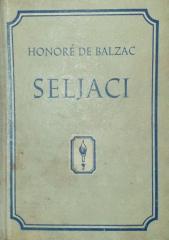
Seljaci
The novel The Peasants (1844) is a realistic depiction of French rural life in the first half of the 19th century. The book leaves the impression of a tragic struggle between the old order and new social forces, making it a key work of French realism.
Sjaj i bijeda kurtizana
The Splendor and Misery of a Courtesan is part of Balzac's collection The Human Comedy. The novel follows the fate of Lucien de Rubempré, an ambitious young poet, and his relationship with the mysterious Vautrin, an ex-convict, in the world of Parisian de
Sjaj i bijeda kurtizana
„Sjaj i beda jedne kurtizane“ deo je Balzakove zbirke „Ljudska komedija“. Roman prati sudbinu Lisjena de Rubamprea, ambicioznog mladog pesnika, i njegov odnos sa misterioznim Votrenom, bivšim osuđenikom, u svetu pariske dekadencije, intriga i morala.
Sjaj i bijeda kurtizana
„Sjaj i beda kurtizana“ deo je Balzakove zbirke „Ljudska komedija“. Roman prati sudbinu Lisjena de Rubamprea, ambicioznog mladog pesnika, i njegov odnos sa misterioznim Votrenom, bivšim osuđenikom, u svetu pariske dekadencije, intriga i morala.
Sjaj i bijeda kurtizana

Tri pripovijetke: Župnik od Toursa / Slavni Gaudissart / Tajna kneginje Cadignan
Zbirka od tri kratke priče Onorea de Balzaka, u veštom prevodu Rudolfa Majksnera, donosi dela *Sveštenik iz Tura*, *Slavni Godisar* i *Tajna princeze od Kadinjana*.
Vragolaste priče
Ова збирка обухвата приче као што су „Лепа империја“, „Лаки грех“, „Краљева милостиња“, „Ђавољи наследник“, „Маршал“ и „Три писара св.