Niccolò Machiavelli
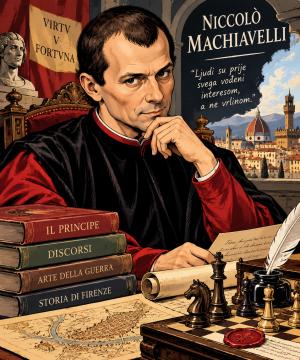
Niccolò Machiavelli, an Italian political thinker, diplomat, historian, writer, and playwright, was born on May 3, 1469, in Florence, where he also died on June 21, 1527. He is considered one of the founders of modern political philosophy and political science, and his name has become synonymous with the pragmatic consideration of governance, power, and statecraft.
From 1498 to 1512, he served as secretary to the Florentine Republic, participating in diplomatic missions and political negotiations. After the Medici family returned to power, he lost his position, was imprisoned and tortured on charges of conspiracy, and subsequently retired to his family estate, where he devoted himself intensively to writing.
His most famous work, The Prince (Il Principe, written in 1513, published in 1532), represents a fundamental treatise on political power, governance, and the preservation of the state. Machiavelli analyzes the relationship between political effectiveness and morality, emphasizing the importance of decisiveness, adaptability, and an understanding of human nature. His distinction between the concepts of virtù (political ability and effectiveness) and fortuna (luck and unpredictable circumstances) occupies a central place in his political thought.
In the work Discourses on Livy (Discorsi sopra la prima deca di Tito Livio, 1531), he examines republican government, civic liberty, and political institutions. He also wrote The Art of War (Dell'arte della guerra, 1521), Florentine Histories (Istorie fiorentine, 1532), and the comedy Mandragola (c. 1518), a significant work of Italian Renaissance drama.
Machiavelli’s thought marks a departure from the medieval conception of politics as subordinate to theology and traditional ethics. His works—characterized by realism, historical analysis, and an examination of the mechanisms of power—have had a lasting impact on political philosophy, historiography, and European literature.