Erich Fromm

Erich Fromm (Frankfurt am Main, March 23, 1900 – Muralto, Switzerland, March 18, 1980) was a German-American psychoanalyst, social psychologist, and philosopher, as well as one of the most important figures in humanistic psychoanalysis. His work integrates psychology, philosophy, sociology, and ethics, focusing centrally on human freedom, love, alienation, and the individual's relationship with society.
He grew up in a Jewish family, studied sociology in Heidelberg—where he earned his doctorate in 1922—and subsequently trained in psychoanalysis. He was associated with the Frankfurt School and the Institute for Social Research, contributing to the latter's development by linking Freudian psychoanalysis with Marxian social critique. Following the Nazi rise to power, he emigrated to the United States and later worked in Mexico as well.
He gained international recognition with the book Escape from Freedom (1941), in which he explores why modern man, faced with insecurity and responsibility, might relinquish freedom in favor of authoritarian systems. In Man for Himself, he lays the foundations of humanistic ethics, while in The Sane Society, he analyzes the psychological consequences of capitalism, conformity, and alienation. His most famous work, The Art of Loving (1956), portrays love as an active capacity requiring knowledge, discipline, responsibility, and care, rather than merely a feeling. In the book To Have or to Be? (1976), he contrasts two fundamental modes of human existence: having and authentic living.
Other significant works include Psychoanalysis and Religion, The Forgotten Language, Marx's Concept of Man, The Anatomy of Human Destructiveness, The Art of Loving, and The Revolution of Hope.
Fromm criticized consumer society, authoritarianism, nationalism, and dehumanization, advocating for a society founded on solidarity, creativity, and human dignity. His accessible yet philosophically grounded works have left a lasting impact on psychology, social theory, and contemporary reflections on love, freedom, and the meaning of human life.
Titles in our offer
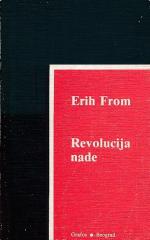
Revolucija nade: Za humanizaciju tehnike
A humanistic study by Erich Fromm. The author analyzes the dangers of a mechanized society and offers a vision of the humanization of technology, the return of hope, active resistance to alienation, and faith in human potential.
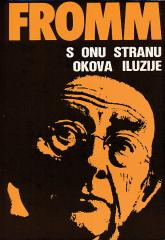
S onu stranu okova iluzije: Moj susret s Marxom i Freudom
In the autobiographical-philosophical work "Beyond the Chains of Illusion", Erich Fromm depicts his own intellectual development through his encounter with the ideas of Karl Marx and Sigmund Freud.
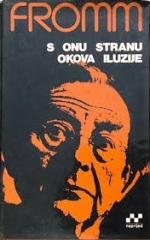
S onu stranu okova iluzije: Moj susret s Marxom i Freudom
Fromm synthesizes the ideas of Marx and Freud, demonstrating that both thinkers share a revolutionary vision of human liberation from social illusions and unconscious constraints.
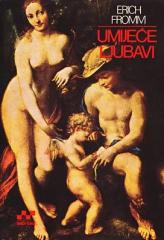
Umijeće ljubavi
A cult work by Erich Fromm. The author does not view love as a mere emotion, but as a skill and art that requires knowledge, effort, maturity, self-discipline, and constant work on one's own personal development.
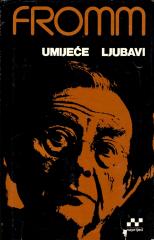
Umijeće ljubavi
In the book *The Art of Loving*, Erich Fromm explores love as a skill that requires knowledge, effort, and responsibility. He distinguishes between different forms of love and emphasizes maturity, respect, and the overcoming of loneliness.
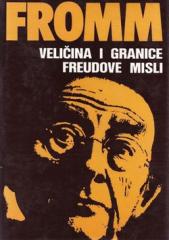
Veličina i granice Freudove misli
In The Greatness and Limits of Freudian Thought, Erich Fromm analyzes Freud's contribution to understanding man and critically exposes the limitations of his theory, especially its biologic and authoritarian aspects.
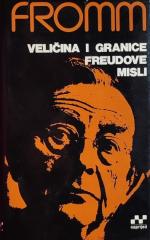
Veličina i granice Freudove misli
Fromm critically evaluates Freud's legacy, praising his revolutionary method of uncovering the unconscious while also challenging his mechanistic, patriarchal, and pessimistic view of human nature.
Zdravo društvo
Erich Fromm explores what makes a society psychologically healthy and what makes it sick. The book represents the crowning achievement of Fromm's social and political philosophy, in which he favors a so-called humane, democratic socialism.
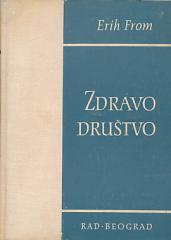
Zdravo društvo
In the book Healthy Society, Fromm tried to show that life in a democracy of the XX. century represents another type of escape from freedom. The analysis of this very escape, in which alienation is the central concept, forms a large part of this book.