Lav N. Tolstoj
Leo Nikolayevich Tolstoy, one of the most important Russian and world writers, was born September 9, 1828, on the Yasnaya Polyana estate into a wealthy noble family. After the death of his parents, he grew up under the guardianship of relatives. He studied oriental languages and law at the University of Kazan, but did not complete his studies. He decided to live on the family estate, devoting himself to self-education and the study of philosophy, literature and natural sciences.
In 1851, he joined his brother in the army in the Caucasus, where his literary work began. During this period, realistic stories inspired by military life were written: Childhood (1852), Boyhood (1854) and Youth (1856) – a three-part autobiographical cycle that affirmed him as a new voice in Russian literature. He participated in the Crimean War, and later described his experiences on the battlefield in the prose of Sevastopol Stories (1855–1856).
After returning from the army in 1856, he traveled around Europe, where he came into contact with the ideas of Western education and democracy. Upon his return to Russia, he founded a school for village children in Yasnaya Polyana and developed his own pedagogical ideas, publishing a collection of texts Alphabet (1872) and the magazine Yasnaya Polyana Reading.
In literary terms, Tolstoy reached his peak with the monumental novels War and Peace (1865–1869)** and Anna Karenina (1873–1877).** The former is an epic fresco of the Napoleonic Wars and the Russian aristocracy, in which history, philosophy, and psychology merge into a synthesis of human experience. Anna Karenina is a psychological novel about love, morality, and social norms.
In his later years, Tolstoy went through a deep spiritual crisis and turned to moral and religious renewal. He wrote The Confessions (1882)**, followed by moral and philosophical writings in which he preached a simple life, nonviolence, and the renunciation of materialism (In What I Believe, the Kingdom of God Within You). His work strongly influenced Gandhi and the pacifist movements of the 20th century.
The narrative works of this period included masterpieces The Death of Ivan Ilyich (1886), The Kreutzer Sonata (1889), Father Sergius, and The Resurrection (1899), in which he dealt with the themes of guilt, redemption, and the meaning of life.
Due to conflicts with the Russian Orthodox Church, Tolstoy was excommunicated from the church in 1901. He died **on 20 November 1910 at the Astapovo railway station, after leaving the family estate in search of spiritual peace.
His rich bibliography includes more than 90 works: novels, short stories, essays, diaries, non-fiction, pedagogical texts and plays. Tolstoy remained a symbol of moral conscience and universal humanism, and his work is based on the idea that the true value of life is in love, work and spiritual freedom.
Titles in our offer
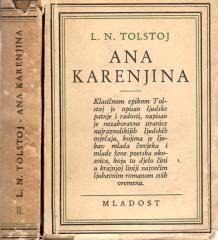
Ana Karenjina
"Anna Karenina" (1875–1877) is Leo Tolstoy's largest and most complex novel, often considered one of the greatest novels in world literature, praised for the depth of its characters and philosophical questions.
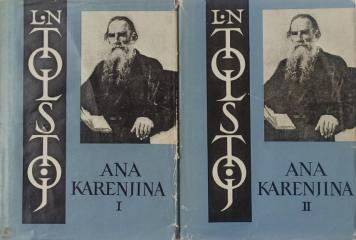
Ana Karenjina
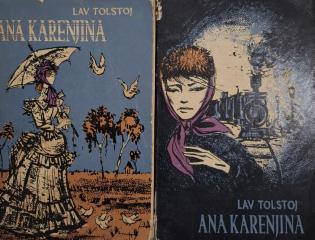
Ana Karenjina 1-2
The novel "Anna Karenina" has been proclaimed the greatest love story of all time, and its author, Count Leo Nikolayevich Tolstoy, the greatest Russian prose writer.
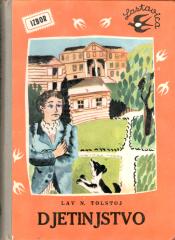
Djetinjstvo
Childhood (1852) is the first book of an autobiographical trilogy (with Adolescence and Youth), where Tolstoy explores the world of childhood through the eyes of a ten-year-old boy, Nikolinka Irtenjev – innocence, joys, sorrows and first traumas.
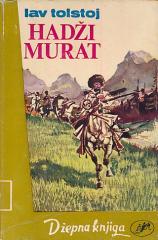
Hadži Murat
Hadži Murat is a novella written by Leo Tolstoy from 1896 to 1904 and published posthumously in 1912 (although in its entirety only in 1917).
Izabrana djela 10: Mećava / Albert / Tri smrti / Otac Sergije / Gospodar i sluga / Kreutzerova sonata / Poslije plesa / Hadži-Murat
Leo N. Tolstoy, a master of literature, explores deep themes of human existence, morality, and society in his novels The Blizzard, Albert, Three Deaths, Father Sergius, The Master and the Servant, After the Dance, and Hadji Murad.
Izabrana djela 11: Djetinjstvo / Dječaštvo / Mladost
Leo Nikolayevich Tolstoy, in his autobiographical trilogy Childhood (1852), Boyhood (1854), and Youth (1857), follows the growing up of Nikolai Irtenyev, a young nobleman whose experience mirrors Tolstoy's own youth.
Izabrana djela 12: Krivotvoreni kupon i druge pripovijesti
Priče „Jutro jednog plemića“, „Iz beleški kneza Nehludova“, „Markerove beleške“, „Vaga“, „Dva husara“, „Kavkaski zarobljenik“, „Falsifikovani kupon“, „Smrtne beleške starca Fjodora Kuzmiča“ i „Zašto?“ istražuju teme morala, društva i duhovnosti.
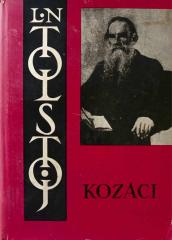
Izabrana djela 8: Kavkaske pripovijetke / Sevastopoljske pripovijetke / Kozaci
Osmi tom Izabranih dela Lava N. Tolstoja objedinjuje romane Kozaci, Kavkaske priče i Sevastopoljske priče, dela inspirisana autorovim iskustvima iz vojne službe na Kavkazu i Krimskog rata.
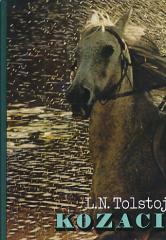
Kozaci
„Kozaci“ (1863) su ključno delo u Tolstojevom ranom stvaralaštvu, most između njegovih autobiografskih dela i njegovih kasnijih epova. Inspirisano Tolstojevim sopstvenim iskustvima na Kavkazu, delo postavlja temelje za njegovu kritiku civilizacije.