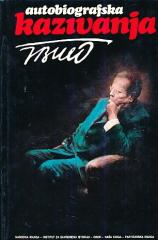
Josip Broz-Tito
Josip Broz Tito (1892–1980), a Yugoslav communist revolutionary, military leader, and statesman, was born on May 7, 1892, in Kumrovec and died on May 4, 1980, in Ljubljana. He was the leader of the Yugoslav Partisans, the long-serving president of Yugoslavia, and a key figure in its one-party socialist system.
A metalworker by trade, he became politically active in the labor movement. He participated in World War I, was held as a prisoner in Russia, and subsequently joined the communist movement. From 1937 onwards, he led the Communist Party of Yugoslavia.
During World War II, he led the Partisan anti-fascist movement, which fought against occupying forces and domestic collaborationist formations. Following the victory in 1945, a socialist Yugoslavia under communist rule was established.
The post-war period was marked by mass executions of prisoners and civilians—including the Bleiburg tragedy and the "Way of the Cross" (Križni put)—as well as political persecutions and crackdowns on actual and perceived opponents of the regime. Repression was carried out by security services, without fair judicial proceedings and involving systematic human rights violations.
A conflict with Stalin in 1948 led to further waves of persecution, most notably the imprisonment of individuals at Goli Otok, where political prisoners were subjected to forced labor, humiliation, and violence. Tito's rule was characterized by the monopoly of the Communist Party, censorship, political surveillance, and restrictions on freedom of expression and association. Constitutional reforms and workers' self-management did not eliminate the system's authoritarian nature.
At the same time, industrialization, urbanization, and the expansion of education and healthcare were implemented. Tito was one of the founders of the Non-Aligned Movement, and Yugoslavia maintained relations with both the East and the West.
His political legacy includes international prestige and social modernization, but also state repression, political crimes, a cult of personality, and an absence of democratic pluralism.
Notable among his works and speech collections are The Struggle for the Liberation of Yugoslavia (Borba za oslobođenje Jugoslavije), Speeches and Articles (Govori i članci), and the multi-volume Collected Works (Sabrana djela). These consist primarily of political speeches, documents, and texts, rather than a literary body of work in the strict sense.
Titles in our offer
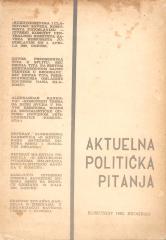
Aktuelna politička pitanja 1962.
Current Political Issues records the moment when the top of the Communist Party of Yugoslavia in 1962 publicly acknowledged the difficulties of reform: in Tito's speech in Split and Ranković's contributions, one sees the crisis, discipline, and struggle o