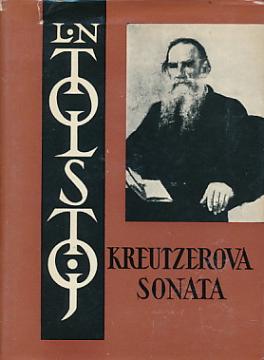
Kreutzerova sonata

Kreutzerova sonata

Lav Nikolajevič Tolstoj

Tolstoy's psychological novella from 1889. It tells the story of jealousy, marital unhappiness, and moral degradation through the confession of the main character, Pozdnyshev, who reveals his tragic life story to random fellow passengers on a train.

Pozdnyshev is a former nobleman and a husband who is facing deep inner turmoil. Obsessed with jealousy, he talks about his unhappy marriage with his wife, which was initially marked by passion and apparent happiness. However, as time passes, distance and distrust grow between them. When his wife begins to play Beethoven's Kreutzer Sonata with the talented violinist Trukhachevsky, Pozdnyshev slowly sinks into paranoia.

Beethoven's composition, full of passion and energy, awakens in him a sick jealousy, he is convinced that there is a love affair between his wife and the violinist. In a fit of rage and blinded by jealousy, Pozdnyshev kills his wife. After the murder, he is acquitted of a crime of passion, but remains emotionally devastated and burdened with remorse.

Through this character, Tolstoy explores the themes of marital (un)happiness, sexual morality and the destructive power of jealousy. He criticizes social norms, the hypocrisy of marriage and possessiveness, questioning the nature of love and passion. The work reflects Tolstoy's own moral dilemma and philosophical reflections on sexuality, purity, and human nature.

The Kreutzer Sonata shocked contemporary society for its explicit depiction of jealousy and criticism of the institution of marriage, but remains relevant today for its deep psychological analysis and moral questions.

Translation
Vjekoslav Kaleb, Malik Mulić, Jakša Kušan, Grigor Vitez, Vladan Desnica
Editor
Jakša Kušan
Dimensions
19.5 x 15 cm
Pages
400
Publisher
Matica hrvatska, Zagreb, 1961.
 
Latin alphabet. Hardcover with dust jacket.
Language: Croatian.

No copies available

The last copy was sold recently.
 

Are you interested in another book? You can search the offer using our search engine or browse books by category.

You may also be interested in these titles

Rat i mir 3

Rat i mir 3

Lav Nikolajevič Tolstoj
Nakladni zavod Matice hrvatske, 1979.
Croatian. Latin alphabet. Hardcover with dust jacket.
5.98
Rat i mir 2

Rat i mir 2

Lav Nikolajevič Tolstoj
Nakladni zavod Matice hrvatske, 1979.
Croatian. Latin alphabet. Hardcover with dust jacket.
5.98
Krivotvoreni kupon i druge pripovijesti

Krivotvoreni kupon i druge pripovijesti

Lav Nikolajevič Tolstoj

The stories Morning of a Nobleman, From the Notes of Prince Nekhludov, Marker's Notes, The Scale, Two Hussars, The Prisoner of the Caucasus, The Forged Coupon, The Death Notes of Old Man Fyodor Kuzmich, and Why? explore themes of morality, society, and sp

Nakladni zavod Hrvatske, 1979.
Croatian. Latin alphabet. Hardcover with dust jacket.
5.62
Selo Stepančikovo

Selo Stepančikovo

Fjodor Mihajlovič Dostojevski

"The Village of Stepanchikovo" is a humorous novel by Dostoyevsky, first published in 1859. This novel, which differs from the later, darker works of the author, is a satirical critique of social relations and human weaknesses.

Svjetlost, 1962.
Serbian. Latin alphabet. Paperback.
4.22 - 4.76
Susret s Bonapartom

Susret s Bonapartom

Bulat Okudžava

Bulat Okudžava often called his historical novel Meeting with Bonaparte his best work.

Narodna knjiga, 1988.
Serbian. Latin alphabet. Paperback with dust jacket.
7.46
Uzorana ledina

Uzorana ledina

Mihail Šolohov

The novel is set in a Cossack community on the Don River during collectivization in the Soviet Union. The work, divided into two parts, follows the dramatic changes in the village of Gremyachi Log as the Bolsheviks introduce collective farms, which provok

Sveučilišna naklada Liber (SNL), 1980.
Croatian. Latin alphabet. Hardcover with dust jacket.
8.326.66