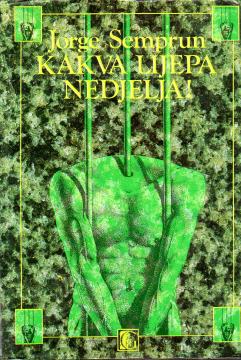
Kakva lijepa nedjelja!

Kakva lijepa nedjelja!

Jorge Semprun

A Spanish writer and member of the resistance movement recalls a Sunday in the Buchenwald concentration camp. Through his memories and reflections, he exposes the horrors of Nazism, but also the tragic delusions of Stalinism.

What a Beautiful Sunday! (1980) is an autobiographical novel by the Spanish-French writer and politician Jorge Semprún. The plot revolves around a single winter Sunday in 1944, which the author spends as a prisoner in the Nazi concentration camp Buchenwald. The title of the novel is imbued with bitter irony: while in the distance he observes the idyllic, snow-covered slopes of Ettersberg and the oak tree under which Goethe wrote, inside the camp fence he witnesses the daily deaths and smoke from the crematorium.

Semprún does not write a classic chronicle of the horrors of the camp, but rather constructs a layered, nonlinear narrative. Using the technique of leaps into the past and the future, the author interweaves memories of the Spanish resistance movement, illegal work in France, and the subsequent political denouement. As a committed communist who fought against fascism, Semprún uncompromisingly analyzes the downside of his own ideology through his camp experience, drawing parallels between the Nazi camps and the Soviet Gulag.

This novel is a poignant philosophical reflection on memory, literature as the only way to survive, and human resilience. Semprún combines personal testimony with profound essayistic insights into the political ideals of the 20th century.

Original title
Quel beau dimanche!
Translation
Ana Kolesarić
Graphics design
Mirko Ilić, Luka Mjeda
Dimensions
24 x 17 cm
Pages
389
Publisher
Grafički zavod Hrvatske (GZH), Zagreb, 1988.
 
Latin alphabet. Hardcover with dust jacket.
Language: Croatian.
ISBN
978-8-63990-095-3

Two copies are available

Copy number 1

Condition:Used, excellent condition

Copy number 2

Condition:Used, excellent condition
 

Are you interested in another book? You can search the offer using our search engine or browse books by category.

You may also be interested in these titles

Imenik lijepih vještina I-II

Imenik lijepih vještina I-II

Miljenko Jergović

In The Directory of Fine Arts, Miljenko Jergović explores diverse topics, from literature to history, celebrating art and excellence. His essays offer deep understanding, imbued with intellectual passion and a love of the written word.

24 sata, 2018.
Croatian. Latin alphabet. Hardcover with dust jacket.
The book consists of two volumes
34.56
Vrtoglavica

Vrtoglavica

Winfried G. M. Sebald

Sebald is not just a storyteller. His narrative process offers a model of consciousness that tells us: to be fully aware of oneself is to suffer from incurable vertigo.

Plato, 2020.
Serbian. Latin alphabet. Paperback.
6.52
Knjiga za Maju: improvizacija na duši

Knjiga za Maju: improvizacija na duši

Marko Tomaš

Tomas' prose book of unrest, disintegration and attempts to unify beings, which means the world, which persistently eludes the author, from the days of nomads who did not create a foothold, to those when virtues and vices change the hierarchy and the mora

V.B.Z, 2023.
Croatian. Latin alphabet. Hardcover.
9.58
I drugi su pjevali o ratu: Odjeci raspada Jugoslavije u engleskoj i američkoj književnosti

I drugi su pjevali o ratu: Odjeci raspada Jugoslavije u engleskoj i američkoj književnosti

Muharem Bazdulj

In this book of essays, Muharem Bazdulj analyzes how the collapse of Yugoslavia and the wars of the 1990s resonated in Anglo-Saxon literature – from pre-war stereotypes to war and post-war depictions.

Biblioteka XX vek, 2013.
Croatian. Latin alphabet. Paperback.
8.24
Dijamantni faraon

Dijamantni faraon

Vesna Krmpotić

After so many books and so many journeys (as if books weren't journeys!), after all collections of poems, narratives, essays and other titles, Diamond Pharaoh is revealed as one of Vesna Krmpotić's trademarks.

V.B.Z, 2002.
Croatian. Latin alphabet. Hardcover.
7.42
Po-etika, knjiga druga

Po-etika, knjiga druga

Danilo Kiš

A collection of interviews that complements the first book of essays from 1972. As a lecturer in Serbo-Croatian at the University of Bordeaux, Kiš reveals in conversations the core of his "po-ethics" - a morally and aesthetically charged vision of literat

Ideje, 1974.
Serbian. Latin alphabet. Paperback.
8.56