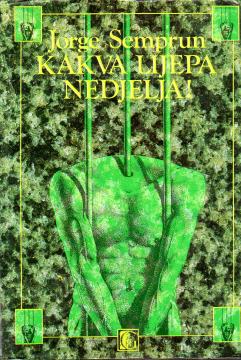
Kakva lijepa nedjelja!

Kakva lijepa nedjelja!

Jorge Semprun

A Spanish writer and member of the resistance movement recalls a Sunday in the Buchenwald concentration camp. Through his memories and reflections, he exposes the horrors of Nazism, but also the tragic delusions of Stalinism.

What a Beautiful Sunday! (1980) is an autobiographical novel by the Spanish-French writer and politician Jorge Semprún. The plot revolves around a single winter Sunday in 1944, which the author spends as a prisoner in the Nazi concentration camp Buchenwald. The title of the novel is imbued with bitter irony: while in the distance he observes the idyllic, snow-covered slopes of Ettersberg and the oak tree under which Goethe wrote, inside the camp fence he witnesses the daily deaths and smoke from the crematorium.

Semprún does not write a classic chronicle of the horrors of the camp, but rather constructs a layered, nonlinear narrative. Using the technique of leaps into the past and the future, the author interweaves memories of the Spanish resistance movement, illegal work in France, and the subsequent political denouement. As a committed communist who fought against fascism, Semprún uncompromisingly analyzes the downside of his own ideology through his camp experience, drawing parallels between the Nazi camps and the Soviet Gulag.

This novel is a poignant philosophical reflection on memory, literature as the only way to survive, and human resilience. Semprún combines personal testimony with profound essayistic insights into the political ideals of the 20th century.

Original title
Quel beau dimanche!
Translation
Ana Kolesarić
Graphics design
Mirko Ilić, Luka Mjeda
Dimensions
24 x 17 cm
Pages
389
Publisher
Grafički zavod Hrvatske (GZH), Zagreb, 1988.
 
Latin alphabet. Hardcover with dust jacket.
Language: Croatian.
ISBN
978-8-63990-095-3

Two copies are available

Copy number 1

Condition:Used, excellent condition

Copy number 2

Condition:Used, excellent condition
 

Are you interested in another book? You can search the offer using our search engine or browse books by category.

You may also be interested in these titles

Zrnca pijeska na obalama vječnosti

Zrnca pijeska na obalama vječnosti

Natalija Vorobjeva-Hržić

Grains of sand on the shores of eternity is a collection of autobiographical stories by the Russian-Croatian writer Natalija Vorobjova Hržić.

Mozaik knjiga, 2016.
Croatian. Latin alphabet. Paperback.
6.48 - 7.32
Eseji

Eseji

Skender Kulenović

Selected works, 4

Veselin Masleša, 1971.
Croatian. Latin alphabet. Hardcover with dust jacket.
7.826.26
Tu nema ničega!

Tu nema ničega!

Dubravka Ugrešić

In her provocative essay, Dubravka Ugrešić considers life in post-socialist Europe and Croatia using the example of spas.

Multimedijalni institut, 2020.
Croatian. Latin alphabet. Paperback.
13.58
Mrka kapa

Mrka kapa

Aristid Teofanović

Mrka kapa is a book of short prose written under the pseudonym Aristid Teofanović, used by Slobodan Blagojević. Blagojević is also known by the heteronym Anhel Antonić (poetry) and other works under his real name.

Feral Tribune, 2001.
Croatian. Latin alphabet. Paperback.
9.36
Crno proljeće / Svijet seksa

Crno proljeće / Svijet seksa

Henry Miller

Black Spring is a collection of essays and short stories by the American writer Henry Miller, which was first published in 1936. "The World of Sex" is Miller's second well-known work, which is particularly controversial due to its explicit content.

Otokar Keršovani, 1967.
Croatian. Latin alphabet. Hardcover.
6.32 - 8.36
Bosna sjete i zaborava

Bosna sjete i zaborava

Enes Karić

Essays about the land of inexhaustible inspirations.

Durieux, 1997.
Croatian. Latin alphabet. Paperback.
5.324.26