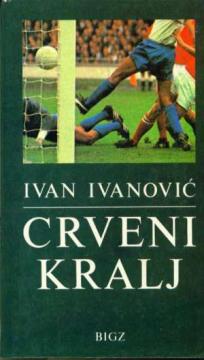
Crveni kralj
Rare book

Crveni kralj

Ivan Ivanović

The Red King (first published in 1972) is a novel by Serbian writer and dissident Ivan Ivanović, banned in Yugoslavia for its criticism of the communist regime. The novel is a classic of Serbian literature for its courage and universal theme of the strugg

Set in the world of Yugoslav football, the novel follows Zoran Jugović, aka Zoka King, a red-haired footballer from the provinces who rises to fame but faces corruption, hypocrisy and social pressures. The life story of the protagonist of this novel is very similar to the circumstances of the famous Ostojić affair, and many of the actors in that affair that shook the football world in the former Yugoslavia are easily recognizable.

Zoka, a talented athlete, symbolizes an individual in conflict with a rigid system. His rise from the southern Serbian province to America, where he becomes a pioneer of “soccer”, reflects the struggle for personal integrity. The novel explores moral dilemmas, corruption in sports and society, and the hypocrisy of the authorities who claim to protect the “little man” while in fact holding him back. Zoka's disillusionment with Yugoslavia, which she calls "the South" or "Yugovina", expresses alienation and criticism of the socialist order, which led to the banning of the book and Ivanović's persecution (dismissal, trial, two-year prison sentence, which he avoided after appealing in 1975).

Through a satirical tone and colorful characters, Ivanovic reveals social contradictions, using football as a metaphor for wider social relations.

Editor
Vidosav Stevanović
Dimensions
18 x 11 cm
Pages
180
Publisher
BIGZ, Beograd, 1984.
 
Latin alphabet. Paperback.
Language: Serbian.

One copy is available

Condition:Used, excellent condition
 

Are you interested in another book? You can search the offer using our search engine or browse books by category.

You may also be interested in these titles

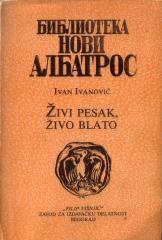
Živi pesak, živo blato

Živi pesak, živo blato

Ivan Ivanović
Filip Višnjić, 1986.
Croatian. Latin alphabet. Paperback with dust jacket.
7.98
Deobe 1-3

Deobe 1-3

Dobrica Ćosić

This work, awarded the NIN Prize for that year, is considered one of the most significant in Serbian literature after World War II.

Prosveta, 1961.
Serbian. Cyrillic alphabet. Hardcover with dust jacket.
The book consists of 3 volumes
11.42
Stotina godina (antikronika)

Stotina godina (antikronika)

Dario Harjaček

The novel One Hundred Years by Dario Harjaček provides a panoramic view of Trešnjevka and its inhabitants through a century of changes, ideologies, and human destinies – a mosaic of Zagreb in which life, art, and history intertwine.

Oceanmore, 2025.
Croatian. Latin alphabet. Paperback.
13.42
Dok ležah na samrti

Dok ležah na samrti

William Faulkner

Faulkner's 1930 novel, a classic example of modernist literature. It is often compared to Joyce's "Ulysses" for its innovative structure, but is more accessible due to its focus on family.

Rad, 1985.
Croatian. Latin alphabet. Paperback.
3.26
Rudnik čvaraka

Rudnik čvaraka

Tomislav Šovagović

The debut work of Croatian writer Tomislav Šovagović, awarded the Josip and Ivan Kozarac Award in 2012, is a dedication to Slavonia – the region of his childhood that the author, born in Dalmatia, observes with foreign but tender eyes.

Mozaik knjiga, 20112.
Croatian. Latin alphabet. Paperback.
11.56
Usta puna zemlje

Usta puna zemlje

Branimir Šćepanović

Roman „Usta puna zemlje“ (1970), remek-delo srpskog pisca Branimira Šćepanovića, psihološki je dubinski istraživač granica ljudske duše, samoće i egzistencijalne slobode, podsećajući na Kafku i Kamija.

BIGZ, 1987.
Serbian. Latin alphabet. Paperback.
3.98