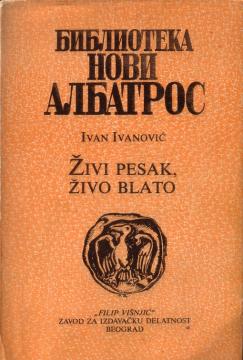
Živi pesak, živo blato

Živi pesak, živo blato

Ivan Ivanović
Editor
Miroslav Josić Višnjić
Graphics design
Petar Dobrović
Dimensions
20 x 13 cm
Pages
207
Publisher
Filip Višnjić, Beograd, 1986.
 
Latin alphabet. Paperback with dust jacket.
Language: Croatian.

One copy is available

Condition:Used, excellent condition
Discounted price: 7.986.38
20% discount is valid until 1/12/26 11:59 pm
 

Are you interested in another book? You can search the offer using our search engine or browse books by category.

You may also be interested in these titles

Crveni kralj

Crveni kralj

Ivan Ivanović

The Red King (first published in 1972) is a novel by Serbian writer and dissident Ivan Ivanović, banned in Yugoslavia for its criticism of the communist regime. The novel is a classic of Serbian literature for its courage and universal theme of the strugg

BIGZ, 1984.
Serbian. Latin alphabet. Paperback.
6.42
Vlak je bio točan

Vlak je bio točan

The first novel by Heinrich Böll. This work (1949) laid the foundation for Böll's later career, in which he continued to explore themes of moral responsibility and the consequences of war, which earned him the Nobel Prize for Literature in 1972.

Grafički zavod Hrvatske (GZH), 1981.
Croatian. Latin alphabet. Paperback.
4.76
Imati i nemati

Imati i nemati

Ernest Hemingway
Izdavačko preduzeće "Rad", 1964.
Serbian. Latin alphabet. Paperback.
2.26
Buran život Amadea Modiglianija

Buran život Amadea Modiglianija

Andre Salmon

A romanticized biography of the Italian painter Amadeo Modigliani, written by the French poet and critic André Salmon.

Mladost, 1960.
Croatian. Latin alphabet. Hardcover.
8.367.52
Operater

Operater

B. D. Benedict

The novel by Serbian-Canadian author Božidar D. Benedict (film director and author of 36 bestsellers) is a pioneering example of the "religious thriller" – a genre invented by Benedict, where instead of spies, invisible agents of God and Satan fight for h

Stari grad, 2000.
Croatian. Latin alphabet. Hardcover.
9.22 - 9.26
U sjeni bregova

U sjeni bregova

Paola Drigo

The novel depicts the tragic fate of Mariuta (Marije Zef) and her younger sister Rosuta. The work shocked contemporaries with its boldness in depicting taboo subjects, and is today considered a classic portrait of female suffering in rural Italy.

Matica hrvatska, 1961.
Croatian. Latin alphabet. Hardcover with dust jacket.
5.32