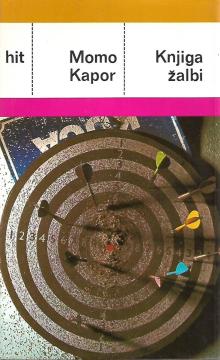
Knjiga žalbi

Knjiga žalbi

Momo Kapor

Momo Kapor's Book of Complaints is a novel about a young bookseller and intellectual who clashes with social and political structures and goes to New York, where he continues his search for freedom, identity, and meaning.

Unlike many of Kapor's urban and romantic novels, The Book of Complaints has a more pronounced social and intellectual dimension. The main character is a bookseller by profession, a man who believes in books, art and culture as fundamental life values. However, due to conflicts with the political structures and bureaucratic mechanisms of the society of the time, he is forced to abandon his previous life and goes to New York, where he begins working in the first Yugoslav bookstore in that city.

His stay in America does not bring him the expected liberation. Instead of the promised world of possibilities, he encounters new forms of loneliness, alienation and the struggle for survival. Through his daily work in the bookstore, he meets emigrants, artists, political refugees and people who are trying to build a new life, but are still haunted by memories of their homeland. These encounters shape a layered picture of emigrant life and a sense of not belonging.

The novel stands out for its reflections on the role of art in a world increasingly dominated by money, power and interests. Kapor particularly develops the motifs of collecting, literature and painting, raising the question of whether beauty can truly change a person or is it just a passing illusion. The character of Šlomović, a tragic art collector, appears in the background, whose fate opens up the themes of the relationship between art, property and human greed.

The Book of Complaints is not just a story about one man but also a novel about a generation of intellectuals torn between ideals and reality, between homeland and the world, between art and everyday survival. Due to its rich gallery of characters, autobiographical elements and reflections on culture, it is considered one of Kapor's more serious and content-wise most ambitious novels.

Editor
Zlatko Crnković
Graphics design
Slobodan Čulić
Dimensions
19.5 x 12 cm
Pages
459
Publisher
Znanje, Zagreb, 1984.
 
Distribution: 10,000 copies
 
Latin alphabet. Hardcover with dust jacket.
Language: Croatian.

Two copies are available

Copy number 1

Condition:Used, excellent condition

Copy number 2

Condition:Used, excellent condition
 

Are you interested in another book? You can search the offer using our search engine or browse books by category.

You may also be interested in these titles

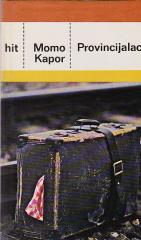
Provincijalac

Provincijalac

Momo Kapor

As much as Foliranti is a story about Kapor's student days in Belgrade in the late fifties, Provincial is a book that evokes memories of his childhood in Sarajevo, where the author spent the first years of his life.

Znanje, 1978.
Serbian. Latin alphabet. Hardcover with dust jacket.
6.42
Skitam i pričam

Skitam i pričam

Momo Kapor

The book I'm wandering and talking was written for several years, and parts of it were published from Sunday to Sunday on the pages of the magazine Duga. Second, significantly expanded edition.

Znanje, 1982.
Serbian. Latin alphabet. Hardcover with dust jacket.
12.42
Put u Jajce

Put u Jajce

Edvard Kocbek

In Put u Jajce, Edvard Kocbek provides personal and political testimony about key moments in Yugoslav history. The book is based on Kocbek's memories from the Second World War, especially the trip to Jajce in 1943.

Znanje, 1978.
Croatian. Latin alphabet. Hardcover with dust jacket.
8.38
Berenikina kosa

Berenikina kosa

Nedjeljko Fabrio

Berenik's Hair by Nedjeljka Fabrija is a historical novel that depicts complex social, political, and cultural changes in Croatia during the 20th century through the fates of individuals and families.

Znanje, 1990.
Croatian. Latin alphabet. Hardcover with dust jacket.
6.32
Ljubavlju opsjednuti

Ljubavlju opsjednuti

Terje Stigen

Obsessed with Love by Terje Stigen is a novel about a love affair that gradually turns into an obsession. Through conflicts, jealousy, and emotional dependence, it depicts the destructive power of uncontrolled passion.

Znanje, 1975.
Croatian. Latin alphabet. Hardcover with dust jacket.
3.98
Graditelj svratišta

Graditelj svratišta

Ivan Aralica

The inn builder is a realistic historical novel, in the tradition of Andrić, but with elements of fantasy that connect Aralica with the oral Croatian literary word, but also with the fantastic literature of Gabriel García Marques, for example.

Znanje, 1987.
Croatian. Latin alphabet. Hardcover with dust jacket.
7.26