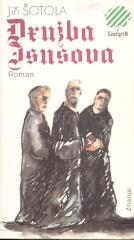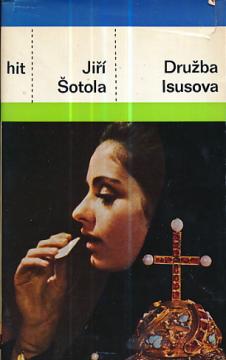
Družba Isusova

Družba Isusova

Jiří Šotola

The Society of Jesus (1969) by Jiří Šotola, the debut work of the Czech poet, is a historical novel set during the Counter-Reformation, which subtly alludes to contemporary conditions in Czechoslovakia under communism.

The plot follows Father Vojtěch Had and Countess Maria Maximiliana, whose fates intertwine in the conflict between the individual and the powerful Catholic Jesuit order. The novel explores themes of obedience, ideological oppression, and the loss of spiritual and human freedom.

Vojtěch Had, a Jesuit priest, is faced with an internal conflict between his conscience and the strict rules of the order, where obedience is the highest value. Countess Maria Maximiliana, passionate and rebellious, comes into conflict with the church hierarchy, which leads to her spiritual and physical downfall. Their paths lead to a tragic end, where ideology suffocates humanity, leaving them as "empty bodily shells". The novel is dark, with a heavy atmosphere, but also layered narrative and dialogues that emphasize moral dilemmas.

Šotola masterfully uses historical context to criticize totalitarian systems, making the novel universal. Croatian critic Ljudevit Bauer compared it to the novel Dervish and the Death of Meša Selimović due to its similar themes of the conflict between the individual and the system. Published in 1975 in Croatia, the novel received critical acclaim and was adapted into a film in 2004, directed by Silvij Petranović.

Original title
Tovaryšstvo ježišovo
Translation
Nikola Kršić
Editor
Zlatko Crnković
Graphics design
Alfred Pal
Dimensions
19.5 x 12 cm
Pages
379
Publisher
Znanje, Zagreb, 1975.
 
Latin alphabet. Hardcover with dust jacket.
Language: Croatian.

Two copies are available

Copy number 1

Condition:Used, excellent condition
Damages or inconvenience notice:
  • Slight damage to the dust jacket

Copy number 2

Condition:Used, very good condition
Damages or inconvenience notice:
  • Traces of patina
  • The cover is missing
 

Are you interested in another book? You can search the offer using our search engine or browse books by category.

You may also be interested in these titles

Družba Isusova

Družba Isusova

Jiří Šotola
Znanje, 1988.
Croatian. Latin alphabet. Paperback.
4.00
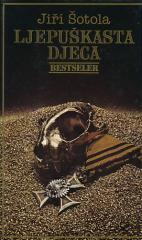
Ljepuškasta djeca

Ljepuškasta djeca

Jiří Šotola

The novel Beautiful Children depicts the world of adolescent rebels in a "re-education" colony - a prison disguised as a school. Written in the spirit of the Prague Spring, the work criticizes the communist system through a dynamic, cinematic narrative.

August Cesarec, 1986.
Croatian. Latin alphabet. Hardcover with dust jacket.
4.82 - 4.84
Dekanov decembar

Dekanov decembar

Saul Bellow

In Bucharest, American Dean Albert Corde is accompanied by his wife, of Romanian origin, whose mother, a famous scientist, is seriously ill.

Veselin Masleša, 1990.
Croatian. Latin alphabet. Hardcover with dust jacket.
4.98
Rosa

Rosa

Heike Geißler

With the brilliant debut of Heike Geißler, she conquered the German audience. With a novel about a girl who leaves her newborn baby because she feels she is losing control over her own life and desires, the author tells the story of a generation of lost p

Fraktura, 2006.
Croatian. Latin alphabet. Paperback.
5.74
Nana

Nana

Émile Zola

The novel "Nana" by Emil Zola is a story about false love, about feigned passion and lust, greed and all emotions related to possessing material things. Everything is embodied in the figure of a woman, possessed of all the vices that society condemns.

Minerva, 1984.
Serbian. Latin alphabet. Hardcover with dust jacket.
4.88 - 4.96
Sati

Sati

Michael Cunningham

Cunningham's novel The Hours (1998, Pulitzer Prize) intertwines three stories about women trapped in the "hour" of life, inspired by Woolf's Mrs. Dalloway. The title alludes to time flowing unstoppably, mixing life, art, and death through the stream of co

Algoritam, 2005.
Croatian. Latin alphabet. Hardcover.
7.38