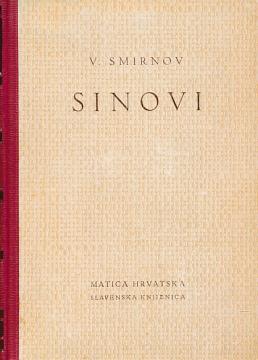
Sinovi

Sinovi

Valerij Smirnov

The novel Sons by the Russian author Valery Smirnov is a powerful socio-psychological story about family, inheritance and moral dilemmas.

The novel is set in socialist Russia, where the consequences of historical turmoil on personal lives are explored through the fates of the members of one family. Through the characters of the sons, the author shows the different paths that individuals choose in the face of political and social changes.

Smirnov focuses on the internal conflicts of the characters, their moral dilemmas and the aspiration to preserve family values ​​at a time when traditional foundations are shaken. The novel explores themes of identity, responsibility and choice, questioning what it means to be a "son" in a wider social context.

The writing style is characterized by a deep psychological analysis and a realistic depiction of everyday life, which allows the reader to identify with the characters and their challenges.

Sons is a significant work that provides insight into the complexity of human relationships and the impact of social changes on family dynamics, leaving a strong impression on the reader.

Translation
Ivana Korobova
Graphics design
Vilko Gliha
Dimensions
20 x 14 cm
Pages
276
Publisher
Matica hrvatska, Zagreb, 1947.
 
Latin alphabet. Hardcover.
Language: Croatian.

Two copies are available

Copy number 1

Condition:Used, excellent condition

Copy number 2

Condition:Used, very good condition
Damages or inconvenience notice:
  • Library stamp
  • Traces of patina
  • Signature of previous owner
 

Are you interested in another book? You can search the offer using our search engine or browse books by category.

You may also be interested in these titles

Bijedna ljubav Musorgskog

Bijedna ljubav Musorgskog

Ivan Lukaš

Ivan Lukaš's novel depicts the tragic love story of the great Russian composer Modest Mussorgsky. The novel follows his unrequited love, artistic struggle, alcoholism, and decline in 19th-century imperial Russia.

Savremena biblioteka, 1940.
Croatian. Latin alphabet. Hardcover with dust jacket.
9.24
Nova skrižaljka

Nova skrižaljka

Pantelejmon Romanov

The New Crossword is a valuable testimony to Russian society in the turbulent post-revolutionary period – honest, sometimes critical, but always interesting and readable. Today it is appreciated as a fine example of Russian prose of the 1920s.

Zabavna biblioteka - Naklada tiskare Narodnih novina, 1930.
Croatian. Latin alphabet. Hardcover.
6.58
Sabrana djela A. P. Čehova #10: Drama bez naslova, Pisma

Sabrana djela A. P. Čehova #10: Drama bez naslova, Pisma

Anton Pavlovič Čehov

The story takes place on a country estate where a group of characters from different social classes gather, faced with boredom, unfulfilled ambitions, and emotional voids.

Zora, 1960.
Croatian. Latin alphabet. Hardcover with dust jacket.
13.56
Crnim po bijelom – priče o knjigama

Crnim po bijelom – priče o knjigama

Mihailo J. Iljin

A popular science book for young people about the history of writing, books, and printing — from prehistoric drawings to the modern printing press. A lively, accessible style by a Soviet author with illustrations by N. Lapshin.

Nakladni zavod Hrvatske, 1946.
Croatian. Latin alphabet. Paperback.
8.26
12 stolica

12 stolica

Ilja Iljf, Jevgenij Petrov

A satirical search for hidden treasure in post-revolutionary Russia. Former nobleman Ippolit Matveyevich Vorobyaninov and con artist Ostap Bender chase after valuables, exposing the greed and absurdities of Soviet society.

Šareni dućan, 2013.
Croatian. Latin alphabet. Hardcover.
16.54
Pisma iz progonstva / Zimske beleške o letnjim utiscima / Krotka

Pisma iz progonstva / Zimske beleške o letnjim utiscima / Krotka

Fjodor Mihajlovič Dostojevski

Fyodor Dostoevsky, one of the greatest writers and visionaries in history, is presented in this edition with a selection from his correspondence (Letters from Exile), an account of his first trip to Europe (Winter Notes on Summer Impressions), and the fam

LOM, 2012.
Serbian. Cyrillic alphabet. Paperback.
6.74