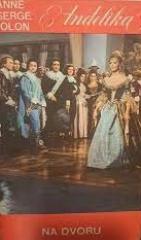
Anđelika I: Markiza Anđela

Anđelika I: Markiza Anđela

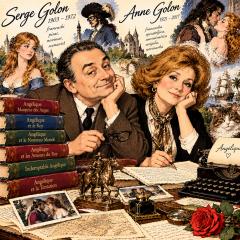
Serge Golon, Anne Golon

The action of this novel, which originally consisted of as many as thirteen sequels (in this edition in eight volumes), is set in France in the seventeenth century. It all begins in 1645 in the run-down castle of the baron of Sansa Montlu who is in debt.

In mid-17th century France, young Louis XIV is struggling for his throne, beggars and thieves haunt Paris and brigands roam the countryside. Fifth child of an impoverished country nobleman, Angélique de Sancé de Monteloup grows up in the Poitou marshlands. Her logical destiny would be to marry a poor country nobleman, have children and spend her life fighting for a meagre subsistence. Destiny has other plans in store for her. At 17, on returning from her education in a convent, she finds herself betrothed to the rich count Jeoffrey de Peyrac (Jeoffrey Comte de Peyrac de Morens, Lord of Toulouse), 12 years her senior, lame, scarred and reputed to be a wizard. For the sake of her family, Angélique reluctantly agrees to the match but refuses the advances of her husband. Peyrac respects her decision and does not pursue his claim to conjugal rights, wishing rather to seduce than use force.

With the passing of months, Angélique discovers the talents and virtues of her remarkable husband: scientist, musician, philosopher; and to her surprise falls passionately in love with him. But Jeoffrey's unusual way of life is threatened by the ambitions of the Archbishop of Toulouse, and soon arouses the jealousy of the young king himself, Louis XIV. Jeoffrey is arrested and charged with sorcery. Angélique will single-handedly take on the might of the royal court and, survive murder and poison attempts on herself in a supreme effort to save Jeoffrey from the stake, to no avail. Instinctively, her whole being intent on revenge and her determination to survive, Angélique, alone and desperate, plunges into the darkness of the Paris underworld.

Original title
Angelique I: La marquise des Anges
Translation
Stanko Škunca
Editor
Stanko Škunca
Dimensions
20.5 x 13 cm
Pages
647
Publisher
Otokar Keršovani, Rijeka, 1966.
 
Latin alphabet. Hardcover with dust jacket.
Language: Croatian.

No copies available

The last copy was sold recently.


Are you interested in another book? You can search the offer using our search engine or browse books by category.

You may also be interested in these titles

Plavi bicikl

Plavi bicikl

Regine Deforges

The French publisher and writer Régine Deforges wrote a handful of novels, but it was not until The Blue Bicycle that she achieved incredible commercial success in France and in the world.

Znanje, 1987.
Croatian. Latin alphabet. Hardcover with dust jacket.
3.36 - 3.42
Vječni žid

Vječni žid

Eugene Sue

"The Wandering Jew" (French: "Le Juif errant") is a novel by Eugène Sue, first published in 1844.

Matica hrvatska, 1969.
Croatian. Latin alphabet. Hardcover.
7.84
Fiškal / Među žabarima

Fiškal / Među žabarima

Ante Kovačić

"Fiškal" is a novel by Ante Kovačić, which deals with themes of identity, social change, and the conflict between tradition and modernity.

Mladost, 1978.
Croatian. Latin alphabet. Hardcover with dust jacket.
5.32
Miss Julia uzima stvar u svoje ruke

Miss Julia uzima stvar u svoje ruke

Ann B. Ross

In it, Miss Julia and her rival became great friends, so much so that the disappearance of her husband's lover caused real chaos in the house.

Mozaik knjiga, 2005.
Croatian. Latin alphabet. Paperback.
6.64
Vuci

Vuci

Milutin Cihlar Nehajev

"Wolves" is a novel by Milutin Cihlar Nehajev that explores complex interpersonal relationships and moral dilemmas through the story of a wolf, a symbol of wilderness and freedom.

Spektar, 1974.
Croatian. Latin alphabet. Hardcover.
2.72 - 3.76
Možeš pljunuti onoga tko bude pitao za nas

Možeš pljunuti onoga tko bude pitao za nas

Robert Perišić

"You can spit on whoever asks about us" by Robert Perišić [first printed in 1999] is a cult book of stories from the nineties. It has not been on sale for years, so many who know Perišić from his more recent works have not had the opportunity to read this

Samizdat B92, 2002.
Croatian. Latin alphabet. Paperback.
11.26