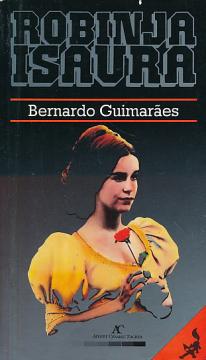
Robinja Isaura

Robinja Isaura

Bernardo Guimaraes

The arduous life of a beautiful slave and the demonic love of her cruel and capricious master at a time when the abolition of slavery in Brazil was not yet in sight.

"The Slave of Isaura" is a novel by the Brazilian author Bernardo Guimarães, which was first published in 1875. The story follows the life of a young slave, Isaura, who dreams of freedom at a time when slavery was still present in Brazil. The novel became known worldwide after it was adapted into the extremely popular telenovela "A Escrava Isaura" in 19761. The telenovela achieved great success and was broadcast in more than 80 countries, including the former Yugoslavia, where it became the first telenovela shown in these regions1.

The book "The Slave of Isaura" explores themes such as love, justice and the struggle for freedom, and is often praised for its emotional depth and social criticism.

Original title
A Escrava Isaura
Translation
Antun Slavko Kalenić
Editor
Bože Čović
Graphics design
Dražen Tončić
Dimensions
18.5 x 11 cm
Pages
276
Publisher
August Cesarec, Zagreb, 1990.
 
Latin alphabet. Paperback.
Language: Croatian.
ISBN
8-63-930208-1

Two copies are available

Copy number 1

Condition:Used, excellent condition
Damages or inconvenience notice:
  • A message of a personal nature

Copy number 2

Condition:Used, excellent condition
 

Are you interested in another book? You can search the offer using our search engine or browse books by category.

You may also be interested in these titles

Štefica Cvek u raljama života

Štefica Cvek u raljama života

Dubravka Ugrešić

Do you like "lovelies"? Whatever you think about them, you'll enjoy this superb pastiche of trivial romance novels.

Mladinska knjiga, 1990.
Croatian. Latin alphabet. Hardcover with dust jacket.
4.94
Pripovetke iz levog i desnog džepa

Pripovetke iz levog i desnog džepa

Karel Čapek

These stories deal with different topics, although most deal with different criminal acts, from fraud and fortune-telling to marriage fraud and murder.

Jugoslavijapublik, 1980.
Croatian. Latin alphabet. Hardcover.
5.22
Deobe 1-3

Deobe 1-3

Dobrica Ćosić

This work, awarded the NIN Prize for that year, is considered one of the most significant in Serbian literature after World War II.

Prosveta, 1961.
Serbian. Cyrillic alphabet. Hardcover with dust jacket.
The book consists of 3 volumes
11.42
V.

V.

Thomas Pynchon

The novel represents a journey into an alternative world – a world that we all belong to from time to time, but of which we would not want to be a part, a world of paranoia and alienation that we are not entirely sure is just an alternative or the bare tr

Čarobna knjiga, 2010.
Serbian. Latin alphabet. Paperback.
21.98
Rudnik čvaraka

Rudnik čvaraka

Tomislav Šovagović

The debut work of Croatian writer Tomislav Šovagović, awarded the Josip and Ivan Kozarac Award in 2012, is a dedication to Slavonia – the region of his childhood that the author, born in Dalmatia, observes with foreign but tender eyes.

Mozaik knjiga, 20112.
Croatian. Latin alphabet. Paperback.
11.56
Andrićeva lestvica užasa

Andrićeva lestvica užasa

Svetislav Basara

A Serbian writer known for his satirical novels, Andrić's Ladder of Horrors dissects the Balkan mentality through a parable of Yugo-nostalgia and national myths. The title alludes to Ivo Andrić as a litmus test for criticism – Balkans claim him or reject

24 sata, 2021.
Serbian. Latin alphabet. Paperback.
11.56