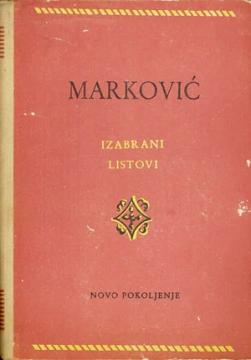
Izabrani listovi

Izabrani listovi

Svetozar Marković

Svetozar Marković (Zaječar, September 21, 1846 - Trieste, March 10, 1875) was an influential Serbian socialist thinker, politician and publicist of the second half of the 19th century. He published Radenik, the first socialist newspaper in Serbia and the Balkans. Marković was a fierce critic of Greater Serbia's politics and a pioneer of the idea of the Balkan Federation. He rejected "historical law", i.e. the restoration of Dušan's empire, as the basis for solving the Serbian question. He said that an attempt to restore this medieval state, which was not only Serbian and on whose territory irreversible historical processes took place, would make Serbia a conqueror on the outside, and a military-police state on the inside. Marković founded federalism as a constant of the Serbian left, as an alternative to the big-state ideology based on "historical law". He also rejected the clerical tradition as a basis for the unity of the Serbian people, and drew a dividing line with right-wing populism.

Graphics design
Ivo Šebalj
Dimensions
20 x 14.5 cm
Pages
235
Publisher
Novo pokoljenje, Zagreb, 1949.
 
Latin alphabet. Paperback.
Language: Croatian.

One copy is available

Condition:Used, very good condition
Damages or inconvenience notice:
  • Traces of patina
  • A message of a personal nature
 

Are you interested in another book? You can search the offer using our search engine or browse books by category.

You may also be interested in these titles

Zaraćeno poraće: Konfliktni i konkurentski narativi o stradanju i iseljavanju Talijana Istre

Zaraćeno poraće: Konfliktni i konkurentski narativi o stradanju i iseljavanju Talijana Istre

Franko Dota

The book analyzes how conflicting historical narratives about the suffering and mass emigration of Italians from Istria and Rijeka developed in Croatia and Italy after World War II (1943–1956), debunking myths and encouraging an empathetic approach to the

Srednja Europa, 2010.
Croatian. Latin alphabet. Paperback.
11.329.06
Knjiga o Srebrenici – spomenar jednog grada

Knjiga o Srebrenici – spomenar jednog grada

Sadik Salimović

Sadik Salimović's Book of Srebrenica (2002) is a memoir of the city: from Ottoman settlement, Islamization and development to the war suffering of 1992–1995 and genocide. It preserves the identity and memory of life before and after the tragedy.

Skupština opštine Srebrenica, 2002.
Croatian. Latin alphabet. Paperback.
11.32
Umiruće tijelo politike: Rat - konstitucija nacionalnog tijela

Umiruće tijelo politike: Rat - konstitucija nacionalnog tijela

Senadin Musabegović

The philosophical and theoretical study by a Bosnian-Herzegovinian author analyzes how the war in Bosnia and Herzegovina from 1992 to 1995 was a biopolitical project of creating a "pure" national body through the systematic killing, expulsion, and rape of

Buybook, 2019.
Croatian. Latin alphabet. Paperback.
11.24
Historija porodice Alibegović: transformacija iz begovske zemljoposjedničke u modernu građansku porodicu

Historija porodice Alibegović: transformacija iz begovske zemljoposjedničke u modernu građansku porodicu

Husnija Kamberović

The book depicts the development of a Bosnian bey family that, throughout the 19th and 20th centuries, transformed from a landowning family into a modern bourgeois family, reflecting broader social changes in Bosnia and Herzegovina.

Udruženje za modernu historiju (UMHIS), 2021.
Croatian. Latin alphabet. Paperback.
18.52
Titostalgija

Titostalgija

Mitja Velikonja

The author explores why Tito remains a popular symbol of stability, social security and independence, despite critical views of his regime. The book maps the cultural, political and everyday manifestations of "Titostalgia".

Biblioteka XX vek, 2010.
Serbian. Latin alphabet. Paperback.
7.36
I drugi su pjevali o ratu: Odjeci raspada Jugoslavije u engleskoj i američkoj književnosti

I drugi su pjevali o ratu: Odjeci raspada Jugoslavije u engleskoj i američkoj književnosti

Muharem Bazdulj

In this book of essays, Muharem Bazdulj analyzes how the collapse of Yugoslavia and the wars of the 1990s resonated in Anglo-Saxon literature – from pre-war stereotypes to war and post-war depictions.

Biblioteka XX vek, 2013.
Croatian. Latin alphabet. Paperback.
8.24