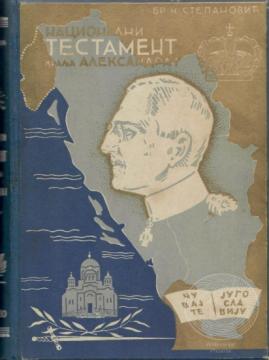
Nacionalni testament kralja Aleksandra I
Rare book

Nacionalni testament kralja Aleksandra I

Branislav M. Stepanović

The author presents the political and ideological legacy of King Aleksandar I Karađorđević the Unifier. The book, published immediately after the king's death, is an attempt to preserve and transmit his political ideals to future generations.

King Alexander I was a key figure in the creation of the Kingdom of Serbs, Croats and Slovenes in 1918, and later the Kingdom of Yugoslavia. His vision was to build a unified Yugoslav nation through a policy of "integral Yugoslavism", which sought to overcome ethnic and political divisions within the state. By introducing the January 6th dictatorship in 1929, he dissolved the parliament, banned political parties and assumed absolute power, believing that this was necessary to preserve the unity and stability of the state.

Stepanović's work describes in detail the king's internal struggle, his motives and disappointments, especially in relation to the failure of the policy of Yugoslav unity. The book also presents the king as a tragic figure, whose death in an assassination in Marseille in 1934 symbolically marked the end of an era and the beginning of new challenges for Yugoslavia.

The National Testament of King Alexander I is not only a biography but also a political manifesto that provides insight into the complex processes of building a modern Yugoslav state and the dilemmas it faced.

Illustrations
Debenjak i Šenšin
Graphics design
Branislav M. Stepanović
Dimensions
24 x 18 cm
Pages
397
Publisher
Jugoslovenska biblioteka "Bratstvo", Beograd, 1936.
 
Cyrillic alphabet. Hardcover.
Language: Serbian.

One copy is available

Condition:Used, very good condition
Damages or inconvenience notice:
  • Damaged back
 

Are you interested in another book? You can search the offer using our search engine or browse books by category.

You may also be interested in these titles

Ante Gotovina

Ante Gotovina

Mladen Pavković

The book deals with General Anto Gotovina, that is, the indictment brought against him at the Hague Tribunal, as well as the political climate in Croatia at the time of the indictment and Gotovina's escape from the Croatian judiciary.

Alineja, 2005.
Croatian. Latin alphabet. Hardcover.
17.36
Prostor šutnje (vremenu usprkos!)

Prostor šutnje (vremenu usprkos!)

Davorin Taslidžić

The book continues a series of the author's professional works dedicated to Baranja.

Zavod za Baranjsku povjesnicu, 2002.
Croatian. Latin alphabet. Paperback.
6.98
Historical Maps of Croatia

Historical Maps of Croatia

From The Penguin Atlas of World History that offers a unique combination of maps and illustrations with detailed chronological summary.

Croatian Information Centre, 1993.
English. Latin alphabet. Paperback.
11.22
Osječka groblja

Osječka groblja

Stjepan Sršan

The book is deeply rooted in the local history and culture of Osijek, with an emphasis on cemetery motifs that serve as a metaphor for memory, death, and disappearance.

Povijesni arhiv u Osijeku, 1996.
Croatian. Latin alphabet. Paperback.
5.26
Od Pola do Malnara: Putnici i istraživači u hrvatskoj kulturi od 13. do 20. stoljeća

Od Pola do Malnara: Putnici i istraživači u hrvatskoj kulturi od 13. do 20. stoljeća

Juraj Bubalo

The book by Zagreb travel writer and professor Juraj Bubalo is a kind of encyclopedia of Croatian travelers and explorers. Unique in Croatian non-fiction, it popularizes the culture of exploration and reminds us that Croats have been part of global discov

Meridijani, 2024.
Croatian. Latin alphabet. Hardcover.
28.32
Hrvatska borba za opstojnost 1918.-1998.

Hrvatska borba za opstojnost 1918.-1998.

Milivoj Kujundžić, Zdravko Dizdar

The book contains an account of the history of Croatia from 1918 to 1998 in four historical periods (1918-1941; 1941-1945, 1945-1990 and 1990-1998).

Hrvatski državni sabor, 2000.
Croatian. Latin alphabet. Hardcover.
6.424.49