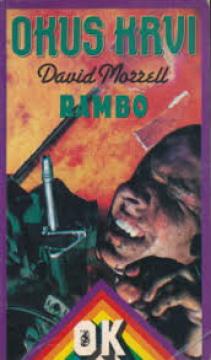
Okus krvi
Rare book

Okus krvi

David Morrell

Vietnam veteran John Rambo is arrested in a small town for vagrancy. Traumatized by the war, he escapes from custody into the mountains, setting off a brutal manhunt. Sheriff Teasle obsessively pursues him as the conflict escalates into a private war that

In the novel "First Blood" (1972), David Morrell creates a tense psychological drama about the conflict between two warriors - John Rambo, a Vietnam veteran with PTSD, and Wilfred Teasle, a sheriff who served in Korea. When Teasle tries to chase the vagabond Rambo out of his small town of Madison, he sets in motion events that will escalate into a full-scale war.

Rambo, a former elite Green Beret soldier, is traumatized by his captivity in Vietnam. When he is brutally treated in a local prison, he experiences flashbacks and flees to the mountains above the town. What begins as a simple pursuit turns into a deadly duel of wills between two stubborn warriors.

Teasle becomes obsessed with capturing Rambo, ignoring the pleas of Rambo's former commander, Colonel Trautman. As bodies fall on both sides, the National Guard and the state police are drawn into the conflict. Rambo uses all his survival and guerrilla skills to survive the hunt.

Morrell doesn't portray either as a complete hero or villain - both are damaged people trapped in a cycle of violence they can't stop. The novel explores themes of war, trauma, pride, and how violence breeds violence, culminating in a tragic ending that shows the true cost of war.

Original title
First Blood
Translation
Anja Picelj
Editor
Ivan Škunca
Graphics design
Ivan Balažević
Dimensions
19.5 x 11.5 cm
Pages
329
Publisher
Otokar Keršovani, Rijeka, 1987.
 
Distribution: 5,000 copies
 
Latin alphabet. Paperback.
Language: Croatian.
ISBN
8-63-850057-2

One copy is available

Condition:Unused
 

Are you interested in another book? You can search the offer using our search engine or browse books by category.

You may also be interested in these titles

Čovjek vrijedan zlata

Čovjek vrijedan zlata

Joseph Heller

Bruce Gold, a literature professor and Jewish man from Brooklyn, is offered a chance to become a high-ranking official in Washington. While trying to write a book about the Jewish experience, he becomes entangled in the absurd world of politics, confronti

Otokar Keršovani, 1987.
Croatian. Latin alphabet. Paperback.
The book consists of two volumes
6.32
Pravila za ljubav

Pravila za ljubav

Penelope Ward, Vi Keeland

Typical of Ward and Keeland: emotional, entertaining, with an unavoidable single father, smoldering romances, humor, steamy scenes, and a happy ending. A book about opposites complementing each other and the power of love to heal wounds.

Znanje, 2025.
Croatian. Latin alphabet. Paperback.
5.26
Topaz

Topaz

Leon Uris

Topaz is a Cold War suspense novel by Leon Uris, published in 1967 by McGraw-Hill. The novel spent one week atop The New York Times Best Seller List, and was Uris's first New York Times number-one bestseller since Exodus in 1959.

Otokar Keršovani, 1970.
Croatian. Latin alphabet. Hardcover with dust jacket.
8.68
Žena vremenskog putnika

Žena vremenskog putnika

Audrey Niffenegger

A cult bestseller praised for its originality, deep emotion, and tender portrayal of love and loss, Audrey Niffenegger's story has captivated readers around the world and, following its film adaptation, has been adapted for television.

Profil Knjiga, 2007.
Croatian. Latin alphabet. Paperback.
7.42
Sluškinjin dnevnik

Sluškinjin dnevnik

Loreth Anne White

The Handmaid's Tale by Loreth Anne White is a suspenseful psychological thriller that explores dark family secrets, obsession, and deadly lies hidden behind the doors of a luxurious home.

Mozaik knjiga, 2024.
Croatian. Latin alphabet. Paperback.
14.24
Armageddon

Armageddon

Leon Uris

Armageddon (1964) by Leon Uris is a historical novel set in post-war Berlin during the 1948-1949 airlift, when the Allies supplied West Berlin amidst the Soviet blockade.

Otokar Keršovani, 1970.
Croatian. Latin alphabet. Hardcover with dust jacket.
8.26