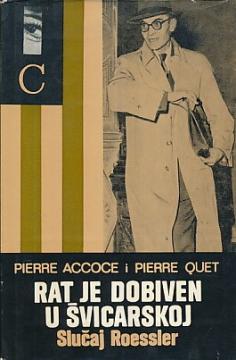
Rat je dobiven u Švicarskoj – Slučaj Roessler
Every spy story always seems like a dubious romance. The story that Accoce and Quet reconstructed with a good journalistic investigation is unlike any other: in the absence of "romanticism", and above all in its importance and consequences.
The book is less about espionage than about conspiracy. It is actually the only coherent, inexorable, surprisingly persistent and effective organization of the German military resistance to Nazism. A group of Oberkommando officers would communicate all decisions made there from the first day to the last. The authors, lest there be disbelief, even insist too much on this "betrayal" - "undeniable", "indisputable". It is not this attitude that is surprising, but the fact that it could manifest itself in the last environment one could imagine: the German General Staff.
The group was formed by ten people, all Bavarians and Protestants, equipped with strong intellectual armor: nine soldiers and one civilian who together, from the beginning of Nazism, gathered an inflexible desire to oppose, based on the strongest spiritual conviction. It is actually the only motive that can make the unbelievable possible.
As soon as war was declared, the conspirators - who saw a sign of providence in the very situation they all found themselves in - decided to give their resistance this unprecedented form. Nazism had to be defeated at any cost, even if that price was Germany itself. In civilian life, Roessler (the only name that was revealed), emigrated to Switzerland, it was up to him to organize - at a higher level - the network itself.
There would be reason for the conspirators to despair. Especially since a year later, Soviet Russia rejected this information with even more suspicion and brutality. Until enlightenment comes. From then on, there will no longer be an enemy's intention, plan, design, operation, which the Russians do not know in advance, down to the smallest detail. An explanation for so many inexplicable "miracles"?
This is the “fantastic source located in Switzerland” that Allen Dulles talks about, which disseminated “information from the German High Command” in “as yet unexplained ways”. To clarify them was precisely the ambition of Accoca and Quet. They did so, but not without indulging in this romance - the staging of characters and reconstructed dialogues, "flashbacks", "tensions" - which they rightly note are absent in reality. Perhaps this is the inevitability of this kind of research and story.
Is it possible to follow the authors to the end of this paradox that would have made nine German officers the real winners - against their own country - of a war that would have been "won in Switzerland" (thanks also to benevolent Swiss neutrality), and of which we can fear in retrospect that without were they and their bridgehead, Roessler, defeated through Hitler?
No copies available
The last copy was sold recently.