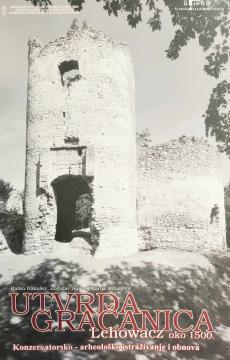
Utvrda Gračanica lehowacz oko 1500.

Utvrda Gračanica lehowacz oko 1500.

Ratko Ivanušec, Marija Mihaljević, Zvonko Bojčić, Zorislav Horvat

Conservation - archaeological research and restoration

The Gračanica-Lehowacz fortress, not far from the village of Baćin Dol and the settlement of Cernik in western Slavonia, is one of the many medieval forts in continental Croatia, the structure of which was destroyed during the Turkish wars of conquest in the first half of the 16th century, but also later in the wars of liberation against the Turks towards the end 17th century Gračanica-Lehowacz fortress was built on the property of the Desislavić noble family at the end of the 15th century or around 1500 in the form of a refuge, that is, a fortress that served as protection against the coming Turkish threat. In that period, the oval-shaped fort consisted of an entrance three-story tower and a perimeter wall with a bastion. A palas was located in the interior along the western perimeter wall. The conservation analysis of the architectural structure of the fort and the findings of preliminary archaeological research have contributed to some new knowledge and views on the architectural layering of the site. Inside the fort, the walls of older fortification complexes dating back to the 13th and 14th centuries were discovered. Of the complete fortification complex of the late medieval fort, the entrance tower, which lacks the third floor and roof, has been preserved to a greater extent, as well as the eastern oval wall and partially the back side of the perimeter wall. .

Editor
Ratko Ivanušec, Marija Mihaljević
Dimensions
23 x 16.5 cm
Pages
39
Publisher
Gradski muzej, Nova Gradiška, 2011.
 
Distribution: 500 copies
 
Latin alphabet. Paperback.
Language: Croatian.
ISBN
978-9-53950-128-8

No copies available

The last copy was sold recently.

 

Are you interested in another book? You can search the offer using our search engine or browse books by category.

You may also be interested in these titles

Hrvati koji su stvarali Europu

Hrvati koji su stvarali Europu

Ivan Tanta

The book collects short biographies of thirty Croatians who, through their work in various fields of science, art and society, have made a contribution to European history.

Stari grad, 2003.
Croatian. Latin alphabet. Hardcover.
6.72 - 6.82
Komunizam i čovjek: Odnos vlasti i pojedinca u Hrvatskoj (1958.–1972.)

Komunizam i čovjek: Odnos vlasti i pojedinca u Hrvatskoj (1958.–1972.)

Josip Mihaljević

Josip Mihaljević's book analyzes the relationship between the government and the individual in communist Croatia (1958–1972), through repressive mechanisms, ideological pressures, and restrictions on personal freedom in the socialist system.

Hrvatski institut za povijest, 2016.
Croatian. Latin alphabet. Hardcover.
17.26
Povijest i kultura Hrvata kroz 1000 godina: gospodarski i društveni razvitak u 18. i 19. stoljeću

Povijest i kultura Hrvata kroz 1000 godina: gospodarski i društveni razvitak u 18. i 19. stoljeću

Horvat
Josip Horvat

This part of Horvat's work depicts the great changes that affected Croatian lands during the 18th and 19th centuries, a period of transition from feudal to modern society.

Knjigotisak d. o. o., 2009.
Croatian. Latin alphabet. Hardcover.
12.22
Od Pola do Malnara: Putnici i istraživači u hrvatskoj kulturi od 13. do 20. stoljeća

Od Pola do Malnara: Putnici i istraživači u hrvatskoj kulturi od 13. do 20. stoljeća

Juraj Bubalo

The book by Zagreb travel writer and professor Juraj Bubalo is a kind of encyclopedia of Croatian travelers and explorers. Unique in Croatian non-fiction, it popularizes the culture of exploration and reminds us that Croats have been part of global discov

Meridijani, 2024.
Croatian. Latin alphabet. Hardcover.
28.32
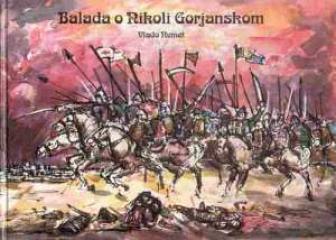
Balada o Nikoli Gorjanskom

Balada o Nikoli Gorjanskom

Vlado Nemet
Tilia, 1994.
Croatian. Latin alphabet. Hardcover.
2.98
Zaraćeno poraće: Konfliktni i konkurentski narativi o stradanju i iseljavanju Talijana Istre

Zaraćeno poraće: Konfliktni i konkurentski narativi o stradanju i iseljavanju Talijana Istre

Franko Dota

The book analyzes how conflicting historical narratives about the suffering and mass emigration of Italians from Istria and Rijeka developed in Croatia and Italy after World War II (1943–1956), debunking myths and encouraging an empathetic approach to the

Srednja Europa, 2010.
Croatian. Latin alphabet. Paperback.
11.328.49