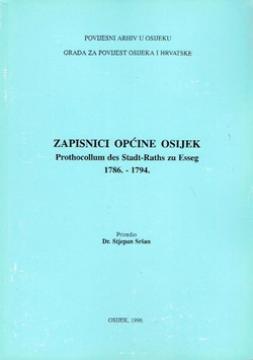
Zapisnici općine Osijek 1786.-1794. (Prothocollum des Stadt-Raths zu Esseg)
The book contains the minutes of the Osijek city administration from the period 1786–1794, after the unification of the Osijek municipalities. As a valuable source, it presents the administrative, economic, social and everyday life of the city at the end
Records of the municipality of Osijek 1786–1794. (Prothocollum des Stadt-Raths zu Esseg), edited and translated for the press by Stjepan Sršan, represent one of the most important published sources for studying the history of Osijek in the second half of the 18th century. The work includes minutes of city council sessions from December 2, 1786 to 1794, a period marked by the administrative reforms of Emperor Josip II. and the unification of the previously separate Osijek Chamber municipalities - Tvrđe, Gornji and Donji grada - into a single city municipality.
The records were originally kept in German and written in German cursive Gothic, reflecting the strong influence of Viennese centralism and the official administration of the Habsburg Monarchy. At the same time, the content of the minutes testifies to the daily functioning of the Croatian urban space and to the presence of the Croatian language in local communication and management.
The minutes contain information on the work of the city authorities, the election of officials, the management of city property, taxes, trades, trade, public order, health and communal matters, as well as on the relations between citizens and the city administration. The documents provide insight into economic conditions, the social structure of the population and the way decisions were made in Osijek at the time.
The value of this book is further enhanced by the fact that a large part of the city's older archival material has been lost, so the preserved minutes are among the rare original written testimonies about the development of Osijek during the 18th century. For this reason, the work is an indispensable source for historians, archivists, researchers of the urban development of Slavonia and anyone interested in the past of Osijek.
One copy is available