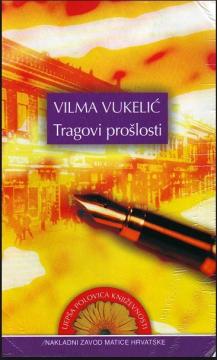
Tragovi prošlosti

Tragovi prošlosti

Vilma Vukelić

With numerous self-analyses, literaryizations and essayistic digressions, the author has reconstructed the picture of Osijek's history.

Memoirs that cover the author's youth, and are interrupted at the beginning of the twentieth century, when she got married. She follows the slow personal growth in space (the city of Osijek) and time, and she is most interested in the way in which an authentic life is incorporated into the context of an authentic city. The author follows the continuity of her own life, and she also achieves persuasiveness by ascending the genealogical tree of her family of Hungarian-Jewish origin. Sometimes he reaches for concrete traces of the time he is talking about - for example, newspaper articles, obituaries, family records, etc., and often describes personal items, clothes, dishes, paintings, hairstyles, furniture, showing this props through a subjective lens.

Translation
Vlado Obad
Editor
Julijana Matanović
Graphics design
Marina Ćorić
Dimensions
20 x 13 cm
Pages
414
Publisher
Nakladni zavod Matice hrvatske, Zagreb, 2003.
 
Latin alphabet. Paperback.
Language: Croatian.
ISBN
9-53-185080-1

No copies available

The last copy was sold recently.
 

Are you interested in another book? You can search the offer using our search engine or browse books by category.

You may also be interested in these titles

Zanimljiva vremena, nemirna vremena: S Lešekom Kolakovskim razgovarao Zbignjev Mencel

Zanimljiva vremena, nemirna vremena: S Lešekom Kolakovskim razgovarao Zbignjev Mencel

Leszek Kolakowski

A book of interviews in which Kołakowski retrospectively describes his life and intellectual journey through the turbulent 20th century – from pre-war Poland, through Nazi occupation, Stalinism, revisionist Marxism, to exile in the West.

Službeni glasnik, 2009.
Serbian. Cyrillic alphabet. Paperback.
The book consists of two volumes
19.44
Banco: Sve ili ništa

Banco: Sve ili ništa

Henri Charrière

In his book Banco – All or Nothing, Henri Charrière describes his life after escaping from prison in French Guiana. Seeking redemption, he embarks on an honest life, but through numerous adventures and shady dealings, he once again tests the limits of fre

Alfa, 1977.
Croatian. Latin alphabet. Hardcover with dust jacket.
11.56
Mi, djeca Solferina

Mi, djeca Solferina

Maroje Mihovilović

Maroje Mihovilović, a Croatian journalist and writer, creates a fascinating, true family saga in his novel We, the Children of Solferino that follows five generations of the Mihovilović-Vukelić family from the end of the 17th century to the turbulent 20th

Profil Knjiga, 2017.
Croatian. Latin alphabet. Hardcover with dust jacket.
31.26
Povratak iz Gulaga: Tajni referat Hruščova

Povratak iz Gulaga: Tajni referat Hruščova

Karlo Štajner

A sequel to his memoir 7000 Days in Siberia, in which he describes his twenty-year imprisonment in Soviet gulags. The book delves into his experiences in the camps, providing additional insights into Steiner's life and reflections on communist ideals.

Globus, 1986.
Croatian. Latin alphabet. Hardcover with dust jacket.
10.768.07 - 11.24
Put u Jajce

Put u Jajce

Edvard Kocbek

In Put u Jajce, Edvard Kocbek provides personal and political testimony about key moments in Yugoslav history. The book is based on Kocbek's memories from the Second World War, especially the trip to Jajce in 1943.

Znanje, 1978.
Croatian. Latin alphabet. Hardcover with dust jacket.
8.38
Tmina zatvorskog sna

Tmina zatvorskog sna

Vladimir Šeks

The plot follows Šeks through the darkness of prison life – the "darkness of sleep" as a metaphor for hallucinations, isolation, and psychological pressure in which reality mixes with nightmares.

Udruga Tin Ujević, 1993.
Croatian. Latin alphabet. Paperback.
9.84