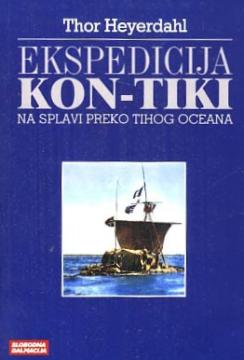
Ekspedicija Kon-Tiki

Ekspedicija Kon-Tiki

Thor Heyerdahl

The Kon-Tiki Expedition was a raft trip across the Pacific Ocean from South America to the Polynesian islands, led by Norwegian explorer and writer Thor Heyerdahl.

The raft was named Kon-Tiki after the Inca god Viracocha, for whom "Kon-Tiki" was claimed to be an old name. Heyerdahl's book about the expedition is called "Kon-Tiki Expedition: Rafting Across the South Seas". A documentary film from 1950 won the Oscar for the best documentary film, and in 2012 a feature film was shot that was nominated for the Oscar for the best foreign film. The Kon-Tiki expedition was financed by private loans, along with equipment donations from the US Army. Heyerdahl and a small team traveled to Peru, where, with the help of a shipyard provided by the Peruvian authorities, they built a raft from balsa logs and other indigenous materials in the style noted by the Spanish conquistadors. The journey began on April 28, 1947. Heyerdahl and five companions rafted for 101 days over 6,900 km (4,300 miles) across the Pacific Ocean before crashing into a reef off Raroia in the Tuamotus on August 7, 1947. The crew successfully made it to land and everyone returned safely. Heyerdahl believed that people from South America could have reached Polynesia in pre-Columbian times. His goal in organizing the Kon-Tiki expedition was to show that there were no technical reasons preventing them from doing so, using only the materials and technologies available to the people of the time. Although the expedition used some modern equipment, such as radios, clocks, maps, a sextant and metal knives, Heyerdahl claimed that these were secondary elements to prove that the raft alone could make the journey. This idea received support from a statistical analysis of the genetic evidence of contact between South America and Polynesia. However, Heyerdahl's complete hypothesis of the South American origin of the Polynesian peoples is largely rejected today. Most of the archaeological, linguistic, cultural and genetic evidence supports a western origin of Polynesians, from Southeast Asia, using sophisticated multihull vessel technologies and navigational techniques during the Austronesian expansion. There is evidence of some gene flow from South America to Easter Island. In 2020, some researchers published a study.

Original title
Kon-Tiki ekspedisjonen
Translation
Petar Mardešić
Editor
Marin Kuzmić, Jakša Fiamengo
Graphics design
Nikša Kuzmić
Dimensions
20 x 14 cm
Pages
302
Publisher
Slobodna Dalmacija, Split, 2005.
 
Latin alphabet. Paperback.
Language: Croatian.
ISBN
9-53-708821-9

No copies available

The last copy was sold recently.

 

Are you interested in another book? You can search the offer using our search engine or browse books by category.

You may also be interested in these titles

Izvješća iz Tarahumare

Izvješća iz Tarahumare

Ivan Rattkay

The book contains three Latin reports by the Croatian Jesuit, nobleman and explorer Ivan Rattkay (Ratkaj, 1647–1683), born in Ptuj (today Slovenia), sent to the provincial of the Austro-Czech Jesuit province from the mission in northern Mexico.

ArTresor naklada, 1998.
Croatian. Latin alphabet. Hardcover with dust jacket.
9.567.65
Povijest otkrića i istraživanja 2: Novi svijet

Povijest otkrića i istraživanja 2: Novi svijet

Nicholas Hordern, Simon Dresner, Martin Hillman

The book describes man's discoveries of parts of planet Earth that were accidental or planned. The period from 50,000 years ago to today's efforts in space exploration is described.

Mladinska knjiga, 1977.
Croatian. Latin alphabet. Hardcover.
37.26 (set)
Đavolji trokut

Đavolji trokut

Richard Winer

For four years, Richard Winer researched the "Devil's Triangle" before publishing the book itself. He sailed his sailboat Running Bowline to all the perimeters of that area, flew over it with an airplane and descended to the seabed at a depth of 400 meter

Stvarnost, 1975.
Croatian. Latin alphabet. Hardcover.
6.26
Tajna Kina

Tajna Kina

Egon Ervin Kisch

The book is a travelogue-reportage work by the "crazy reporter" Egon Ervin Kisch, which presents impressive accounts of China in the turbulent period of the 20th century.

Binoza, 1934.
Croatian. Latin alphabet. Hardcover with dust jacket.
14.98
Putujući Crnom Gorom

Putujući Crnom Gorom

Draško Šćekić

Traveling through Montenegro is a documented, particularly picturesque and interesting literary guide through the space and time of Montenegro.

NIO Univerzitetska riječ, 1987.
Croatian. Latin alphabet. Hardcover with dust jacket.
9.28
Peta strana svijeta

Peta strana svijeta

Jasen Boko

Through travelogues and personal accounts, Jasen Boko describes South America – a continent of contrasts, passion and unrest. Combining history, culture and personal reflections, he searches for what it means to be “at home” in the world.

V.B.Z, 2006.
Croatian. Latin alphabet. Paperback.
11.2210.10