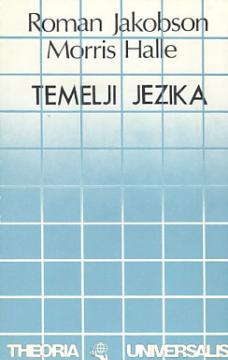
Temelji jezika

Temelji jezika

Roman Jakobson, Morris Hale

A classic text of modern phonology and one of the most famous works of literary theory – a fundamental work that establishes the theory of distinctive features as the basis of the linguistic sound system.

The book was written in collaboration with the American Slavist Morris Halle and represents a systematization of the facts of modern phonology, the development of theories of distinctive features and binary oppositions in the widest extension of the linguistic phenomenon.

The book has two main parts: Part I: Phonology and Phonetics – introduces 12 pairs of distinctive features (later expanded to more). Each phoneme is defined by binary values ​​(+/-) according to acoustic and articulatory criteria:

  • vocalic: vowel/consonant, compact/diffuse, acute/grave, flat/scattered
  • consonantal: interrupted/continuous, strident/dull, nasal/oral, voiced/voiceless
  • additional: sharp/blunt, tense/relaxed, etc. This binary hierarchy (laws of implication) explains universal patterns in the world's languages: why some oppositions exist only if others exist, how phonemes develop in children and disappear in aphasia. Examples from English, Russian and other languages ​​show how phonemes are distinguished by minimal pairs (e.g. Bitter/Chitter in New York).

Part II: Two Aspects of Language and Two Types of Aphasic Disturbances – Jakobson applies Saussure's axes: selective (paradigmatic, similarity) and combinative (syntagmatic, adjacency). Aphasias reveal the core of language:

  • similarity aphasia (continuous, Wernicke) – problems with paradigm, metaphors, lexical choice.
  • adjacency aphasia (interrupted, Broca) – problems with syntagma, grammar, metonymy. This shows that language is not just sound, but a structure of oppositions.

The work is canonical for structural phonology, influenced semiotics, psycholinguistics and literary theory (poetic function).

Original title
Fundamentals of Language
Translation
Ivan Martinčić, Ante Stamać
Editor
Ante Stamać
Graphics design
Pavao Lerotić
Dimensions
20 x 13 cm
Pages
109
Publisher
Globus, Zagreb, 1988.
 
Distribution: 2,000 copies
 
Latin alphabet. Paperback.
Language: Croatian.
ISBN
8-63-430530-9

Two copies are available

Copy number 1

Condition:Used, excellent condition

Copy number 2

Condition:Used, excellent condition
 

Are you interested in another book? You can search the offer using our search engine or browse books by category.

You may also be interested in these titles

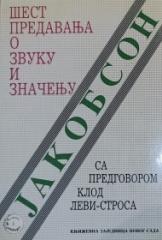
Šest predavanja o zvuku i značenju

Šest predavanja o zvuku i značenju

Roman Jakobson
Književna zajednica Novog Sada, 1986.
Serbian. Cyrillic alphabet. Paperback.
7.54
Semantika

Semantika

Gaetano Berruto

Beruto objašnjava šta je značenje u jeziku i kako se ono formira, tumači i prenosi. On detaljnije razrađuje različite pristupe semantici, uključujući odnos između reči, pojmova i stvarnosti.

Aktant d. o. o., 1994.
Croatian. Latin alphabet. Paperback.
7.98
Besede: Izbor iz svetskog besedništva

Besede: Izbor iz svetskog besedništva

„Besede: izbor iz svetskog besedništva“ je antologija besedništva koju je uredila Vera Popović, sa predgovorom Živojina Simića. Uz nekoliko izuzetaka, propovedi u ovoj zbirci sada su ili prvi put prevedene ili ponovo prevedene za ovu antologiju...

Kultura, 1967.
Serbian. Latin alphabet. Hardcover.
12.98
Ususret Arijadni

Ususret Arijadni

Bogdan Mesinger

Lingvistički i kulturološki ogledi o transmedijalnosti

Matica hrvatska, 2007.
Croatian. Latin alphabet. Paperback.
6.48
Putovima hrvatskoga književnog jezika

Putovima hrvatskoga književnog jezika

Zlatko Vince

Knjiga je i danas obavezna literatura na filološkim fakultetima jer prvi put sustavno povezuje jezik s književnošću i društvenim kontekstom. Napisana je jasno, bez ideoloških isključivosti, što je 1990. bilo rijetkost.

Nakladni zavod Matice hrvatske, 1990.
Croatian. Latin alphabet. Hardcover with dust jacket.
17.26
Rječnik stranih riječi

Rječnik stranih riječi

Vladimir Anić, Ivo Goldstein

Sveobuhvatan leksikon koji objašnjava podrijetlo, značenje i upotrebu stranih riječi u hrvatskom jeziku. Prvo izdanje, nastalo nakon Anićeva ranijeg Rječnika stranih riječi (1982.), prošireno je Goldsteinovom suradnjom, donoseći veći broj pojmova.

Novi Liber, 1999.
Croatian. Latin alphabet. Hardcover.
22.4620.21