Proljetne vode

Proljetne vode

Ivan Sergejevič Turgenjev

Spring Waters (1872) is a lyrical novel about first love, the transience of youth, and the impossibility of man to love without losing his innocence or freedom. A classic work of Russian realism about love that changes life but does not save it.

The story takes place in two times: in the 1840s in Germany and 20 years later in Russia. The main character, Dmitry Pavlovich Sanjin (or Sanin), a young Russian nobleman, travels through Europe and in Frankfurt (or Mainz) he meets the Italian Roselli family: the beautiful 19-year-old Gemma, her widowed mother and younger brother Emanuel. Gemma is engaged to a rich German man, Klüber, but Sanjin falls in love with her, and she with him. After dramatic events (a duel, the breakup of the engagement), Sanjin proposes to her and gets her consent.

However, love does not come true: Sanjin meets Maria Nikolaevna Polozova, a rich, seductive and manipulative widow who seduces him and drags him into a passionate adventure. Sanjin betrays Gemma, loses her forever and remains trapped in an empty, rich life with Maria – a symbol of slavery to passions and the loss of youthful purity.

The novel is introspective, melancholic, and autobiographical (Turgenev draws from his own experiences). The theme is the transience of the spring waters of youth: love is strong but short-lived, and man is left alone with the memory of what he could have had.

Translation
Ljubo Perković, Vladimir Babić, Maja Vitrisal, Drago Dujmić
Editor
Ivo Sanader
Graphics design
Nenad Dogan
Dimensions
20 x 12.5 cm
Pages
298
Publisher
Logos, Split, 1985.
 
Distribution: 10,000 copies
 
Latin alphabet. Hardcover with dust jacket.
Language: Croatian.

One copy is available

Condition:Used, excellent condition
 

Are you interested in another book? You can search the offer using our search engine or browse books by category.

You may also be interested in these titles

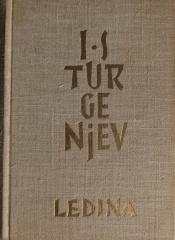
Ledina

Ledina

Ivan S. Turgenjev
Matica hrvatska, 1963.
Croatian. Latin alphabet. Hardcover.
4.98
Lovčevi zapisi

Lovčevi zapisi

Ivan Sergejevič Turgenjev
Svjetlost, 1974.
Croatian. Latin alphabet. Hardcover.
4.00
Očevi i djeca

Očevi i djeca

Ivan S. Turgenjev

The novel explores the clash of generations and ideologies in 19th-century Russia, focusing on the conflict between traditionalism and nihilism. Set in rural Russia, the work follows the fates of young intellectuals and their relationships with their fami

Globus, 2005.
Croatian. Latin alphabet. Hardcover.
5.46
Znamenovanje ruske revolucije

Znamenovanje ruske revolucije

Lav N. Tolstoj

Tolstoy interprets the 1905 revolution as a moral upheaval: violence does not bring justice, but a new yoke. He sees lasting liberation in personal conscience, non-violence and Christian love, not in the state and coercion.

St. Kugli, 1907.
Croatian. Latin alphabet. Hardcover.
17.24
Svjetska knjižnica, Sv. 3.

Svjetska knjižnica, Sv. 3.

Fjodor M. Dostojevski, Henryk Sienkiewicz

The World Library, Volume 3, edited and published by Iso Velikanović, contains excerpts from The Brothers Karamazov by F. M. Dostoevsky and Without Dogma by H. Sienkiewicz. Designed for self-binding of individual works.

Vlastita naklada, 1903.
Croatian. Latin alphabet. Paperback.
17.24
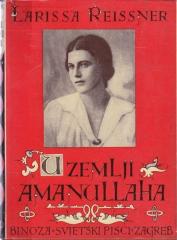
U zemlji Amanullaha

U zemlji Amanullaha

Larissa Reissner

A vivid account of the author's trip to Afghanistan in 1921-1922, a country in a turbulent period of modernization under the reformist king Amanullah Khan, the clash of tradition and the new age, and the exotic life of Afghan society.

Naklada Binoza, 1935.
Croatian. Latin alphabet. Hardcover with dust jacket.
3.22 - 7.54