Veliki svjetski muzeji: Louvre, Pariz (drugi dio)

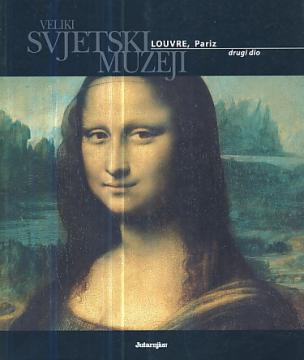
Veliki svjetski muzeji: Louvre, Pariz (drugi dio)

Emanuele Castellani

The first ruler who began to see the Louvre as the "palace of the Muses" was Louis XV.

For him, it was supposed to be a place where works of art from French collections would be systematically collected in order to preserve them for future generations and show them to the public. Nevertheless, the Louvre will become a museum in the true sense of the word only after the French Revolution, when the "royal gallery" becomes the "national gallery" and begins to be enriched with a huge number of new works, most of them spoils from the wars fought during the Republic and then under Napoleon Bonaparte (while was in power, the museum bore his name) when the most important works of art of all time arrive in Paris from all over Europe. During the Bourbon restoration, the plundered lands recovered only a part of the stolen art.

Translation
Srećko Jurišić
Editor
Gordan Zečić
Dimensions
23 x 19.5 cm
Pages
138
Publisher
EPH media d. o. o., Zagreb, 2012.
 
Latin alphabet. Paperback.
Language: Croatian.
ISBN
978-9-53338-007-0

No copies available

The last copy was sold recently.


Are you interested in another book? You can search the offer using our search engine or browse books by category.

You may also be interested in these titles

Povijest namještaja - ilustrirana primjerima Muzeja Slavonije

Povijest namještaja - ilustrirana primjerima Muzeja Slavonije

Danica Pinterović.

An overview of the development of furniture from the Baroque to the Modern period, illustrated with objects from the collections of the Museum of Slavonia. Through style, materials and function, the book shows how lifestyle and living culture changed.

Muzej Slavonije, 1952.
Croatian. Latin alphabet. Paperback.
9.26
Dragica Cvek-Jordan

Dragica Cvek-Jordan

Tonko Maroević

As a whole, the book serves as an authoritative interpretation and valorization of the artist's oeuvre, highlighting her uniqueness and contribution to Croatian modern figuration.

Grafički zavod Hrvatske (GZH), 1987.
Croatian. Latin alphabet. Paperback.
9.98
Plitvička jezera

Plitvička jezera

Čedo Prica

Photomonography about Plitvice Lakes - in addition to Croatian, the text is simultaneously in German, English, Italian and French.

Grafički zavod Hrvatske (GZH), 1977.
Croatian. Latin alphabet. Hardcover with dust jacket.
14.36
Ernst Barlach: Lithographien, Holzschnitte

Ernst Barlach: Lithographien, Holzschnitte

Jens Kraubig

The exhibition catalogue represents a significant segment of the oeuvre of the German expressionist Ernst Barlach, who, in addition to being a sculptor, was also a prolific graphic artist and writer. The catalogue is accompanied by an appendix with a tran

Institut für Auslandsbeziehungen, 1989.
Croatian. Latin alphabet. Paperback.
11.32
Umetnost na tlu Jugoslavije : Islamska minijatura

Umetnost na tlu Jugoslavije : Islamska minijatura

Zagorka Janc

Through these "miniatures", the author brings the reader closer to the world of different traditions, emphasizing the beauty, mysticism, and complexity of Islamic culture, but also universal themes such as transience, identity, and the meaning of life.

Jugoslavija, 1985.
Serbian. Latin alphabet. Hardcover.
9.00
Picasso: Skulpture

Picasso: Skulpture

Roland Penrose

"Picasso: Sculptures" by Roland Penrose is a small monograph in the "Little Art Encyclopedia" series (No. 72). It presents Picasso's sculptures with an introduction and black and white reproductions.

Nolit, 1967.
Serbian. Latin alphabet. Paperback.
4.26