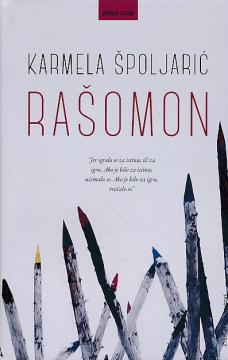
Rašomon

Rašomon

Karmela Špoljarić

If the stories and their protagonists could choose, the endings would certainly be different. But the rolling speculations that life and literature place under our feet do not care about such things.

Their only goal is for us to accept the game, regardless of whether they know how to play it or not. Her end will be evaluated and interpreted by many who happened to be in that game, each from their own perspective. Rašomon by Karmela Špoljarić, an author previously known as a skilled and filigree subtle storyteller, takes reality as the basis for the literary world she creates. The novel of the character, one of the anti-heroes of our time, is mostly written in the second person singular, in order to emphasize his remoteness, displacement and powerlessness, as a result of events from the past and present. Although all of them are narrated and filtered through his consciousness, the 'supplement' of others, those who enable a change in the narrative perspective and a change in the perception of the truth of the event, only emphasizes this distance from himself and the world.

Editor
Jagna Pogačnik, Nermina Husković
Graphics design
Jasna Goreta
Dimensions
21.5 x 14 cm
Pages
159
Publisher
Hena Com, Zagreb, 2020.
 
Latin alphabet. Hardcover with dust jacket.
Language: Croatian.
ISBN
978-9-53259-283-2

One copy is available

Condition:Used, excellent condition
 

Are you interested in another book? You can search the offer using our search engine or browse books by category.

You may also be interested in these titles

Hromi plemić

Hromi plemić

Aleksej N. Tolstoj
Progres.
Serbian. Latin alphabet. Paperback.
4.99
Ti si to ovdje

Ti si to ovdje

Šime Vučetić
Zadružna štampa, 1982.
Croatian. Latin alphabet. Paperback.
4.99
Jedan dan Ivana Denisoviča

Jedan dan Ivana Denisoviča

Aleksandar Solženjicin
Prosveta, 1988.
Serbian. Latin alphabet. Paperback.
3.26 - 3.56
Slavna budućnost naše zemlje

Slavna budućnost naše zemlje

Mirko Golubić

The book is a genre of popular science literature with elements of technological vision and futurism, characteristic of the era in which it was created – the time of the Cold War, the space race, and great expectations from science.

Znaci vremena, 1972.
Croatian. Latin alphabet. Paperback.
2.98
Pukovniku nema tko da piše

Pukovniku nema tko da piše

Gabriel Garcia Marquez
Znanje, 1998.
Croatian. Latin alphabet. Paperback.
4.86
Zoe

Zoe

Momo Kapor

The novel "Zoe" (1978), one of Momo Kapor's most popular works, follows Arsen Lero, a 39-year-old art historian from the fictional Republic of Kosiliya – a small island under an authoritarian regime.

Znanje, 1978.
Croatian. Latin alphabet. Hardcover with dust jacket.
6.38