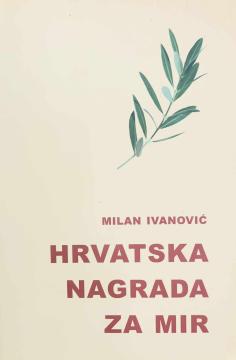
Hrvatska nagrada za mir

Hrvatska nagrada za mir

Milan Ivanović

Peace, as a social-individual category and desire, historically speaking, is the old dream of the sages of the always restless humanity exposed to the sufferings and violence of war.

The first part of the book gives a brief overview of the history of peace awards in the world and shows some of the most important peace awards on all continents with an emphasis on a selection of the more famous in European countries and a special analysis of the situation in post-socialist transition countries. The second part of the book presents all the winners: (a) "Krunoslav Sukić" awards, (b) "Krunoslav Sukić" awards for work in the local community, non-violent action of the year and similar activities as well as special awards, and (c) "Krunoslav Sukić" awards Krunoslav Sukić" Book of the Year, (d) Awards "Peaceful School". In the third part of the book - Concluding considerations - the conclusions of the analysis are given: - how to promote just, peaceful and inclusive societies; - how peace organizations make significant contributions to the construction of civil society in Croatia, - the concept of the peace prize as a social project is clarified, and - recommendations for the future are given.

Editor
Renata Trischler
Graphics design
Ladislav Bognar
Dimensions
24 x 17 cm
Pages
182
Publisher
Alberta naklada, Osijek, 2019.
 
Distribution: 500 copies
 
Latin alphabet. Paperback.
Language: Croatian.

One copy is available

Condition:Used, excellent condition
Discounted price: 5.363.75
30% discount is valid until 3/31/26 11:59 pm
 

Are you interested in another book? You can search the offer using our search engine or browse books by category.

You may also be interested in these titles

Na vratima Požeške doline

Na vratima Požeške doline

Dragutin Pavličević

A classic of local historiography, it depicts the history, geography and culture of the Požega Valley from prehistoric times to the modern era. The work describes the region's strategic position, the influences of the Romans, Ottomans and Habsburgs, with

Matica hrvatska, 1961.
Croatian. Latin alphabet. Paperback.
12.36
Tragom prošlosti Broda

Tragom prošlosti Broda

Vladimir Rem

A local feuilleton chronicle of Slavonski Brod from Roman times (Marsunija), through Turkish rule, the Military Border and the fortress to the 19th/20th century. A warm, nostalgic account of the history, customs and sights of the town.

Vlastita naklada, 1965.
Croatian. Latin alphabet. Paperback.
6.72
Korčulanska brodogradnja / Shipbuilding in Korčula

Korčulanska brodogradnja / Shipbuilding in Korčula

Dušan Kalogjera

The monograph Korčula Shipbuilding by Dušan Kalogjera explores the rich history of shipbuilding on the island of Korčula, a key center of Adriatic maritime tradition from the Middle Ages to the present day.

Prometej, 1998.
Croatian. Latin alphabet. Hardcover with dust jacket.
87.32
Od Pola do Malnara: Putnici i istraživači u hrvatskoj kulturi od 13. do 20. stoljeća

Od Pola do Malnara: Putnici i istraživači u hrvatskoj kulturi od 13. do 20. stoljeća

Juraj Bubalo

The book by Zagreb travel writer and professor Juraj Bubalo is a kind of encyclopedia of Croatian travelers and explorers. Unique in Croatian non-fiction, it popularizes the culture of exploration and reminds us that Croats have been part of global discov

Meridijani, 2024.
Croatian. Latin alphabet. Hardcover.
28.32
Partizanska i komunistička represija i zločini u Hrvatskoj 1944.-1946.: dokumenti. Knjiga 2: Slavonija, Srijem i Baranja

Partizanska i komunistička represija i zločini u Hrvatskoj 1944.-1946.: dokumenti. Knjiga 2: Slavonija, Srijem i Baranja

Vladimir Geiger

The first critical edition of original documents (187 of them) of units and institutions of the NOV and PO of Yugoslavia and Croatia on the actions taken against defeated military and political opponents in the area of ​​Slavonia, Srijem and Baranja befor

Hrvatski institut za povijest, 2006.
Croatian. Latin alphabet. Hardcover.
15.42
Osječka groblja

Osječka groblja

Stjepan Sršan

The book is deeply rooted in the local history and culture of Osijek, with an emphasis on cemetery motifs that serve as a metaphor for memory, death, and disappearance.

Povijesni arhiv u Osijeku, 1996.
Croatian. Latin alphabet. Paperback.
5.26