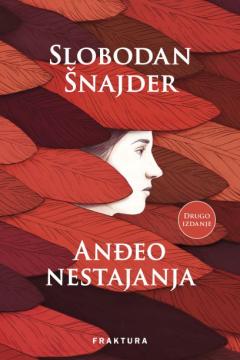
Anđeo nestajanja

Anđeo nestajanja

Slobodan Šnajder

The Vanishing Angel is a magnificent historical epic and the author's dedication to Zagreb and its silent heroes. The fate of the heroine Anđa Berilo is the fate of a nation and a city, a story about those who believe in ideals even when they are irrevoca

Just before the Second World War, a young, beautiful and bright girl from Žumberka, Anđa Berilo, came to work in a house in Zagreb's Ilica, a two-story house built for rent by a wealthy Jewish wholesaler, as a maid for a gentleman in the city. In difficult war times, she will find out what her neighbors and employers are like - some will end up in a camp, others will join the Ustasha, others will go to a sanatorium for treatment...

Anđa will fall in love with a young communist and embrace the ideals of equality and freedom. Her modest little room will become a haven for an extremely important illegal. However, her lover will be killed in Trg N. after his arrest, and she will have to flee to the partisans. When she returns to liberated Zagreb, she does not want privileges. Fair and incorruptible, she becomes suspicious of her friends who take her to Goli otok. Anđa Berilo will want to correct the injustice, but new times will touch her and the house where she lived.

Editor
Seid Serdarević
Graphics design
Ivan Stanišić
Dimensions
24 x 17 cm
Pages
448
Publisher
Fraktura, Zaprešić, 2023.
 
Latin alphabet. Hardcover with dust jacket.
Language: Croatian.
ISBN
978-9-53358-602-1

No copies available

The last copy was sold recently.
 

Are you interested in another book? You can search the offer using our search engine or browse books by category.

You may also be interested in these titles

Isus i moja sjena

Isus i moja sjena

Nikola Šop

Jesus and My Shadow (1934) is Nikola Šop's most famous collection. The poet intimately humanizes Jesus and brings him into the everyday life of the poor, nature, and ordinary things. In a Franciscan spirit, he celebrates simplicity, poverty, and the divin

Matica hrvatska, 1934.
Croatian. Latin alphabet. Hardcover.
26.44
Rakovica: o 60. godišnjici smrti Eugena Kvaternika

Rakovica: o 60. godišnjici smrti Eugena Kvaternika

Milutin Cihlar Nehajev

Nehajev's "Rakovica", in the edition edited by Blaž Jurišić, presents the Rakovica Rebellion, its causes and ideas. Nehajev did not finish the book due to his sudden death; it was completed and edited by Blaž Jurišić.

Matica hrvatska, 1932.
Croatian. Latin alphabet. Hardcover.
5.42 - 8.266.61
Novi pripovjedači

Novi pripovjedači

Ljubomir Maraković

A collection of literary criticism and studies by Ljubomir Maraković. The author analyzes and evaluates contemporary Croatian storytellers and novelists of the interwar period, emphasizing their artistic values ​​from a Catholic and ethical perspective.

Hrvatsko književno društvo Sv. Jeronima, 1929.
Croatian. Latin alphabet. Hardcover.
8.74
Povijest hrvatske književnosti. Knjiga I. Od humanizma do potkraj XVIII. stoljeća

Povijest hrvatske književnosti. Knjiga I. Od humanizma do potkraj XVIII. stoljeća

Branko Vodnik

The first book covers Croatian literature from humanism (15th century) to the end of the 18th century. The first systematic overview of older Croatian literature. The book begins with a comprehensive introduction by Vatroslav Jagić on Croatian Glagolitic

Matica hrvatska, 1913.
Croatian. Latin alphabet. Paperback.
17.34
Hrvatske narodne pjesme – Knjiga deveta: Junačke pjesme (odio prvi, sveska šesta)

Hrvatske narodne pjesme – Knjiga deveta: Junačke pjesme (odio prvi, sveska šesta)

A collection of heroic, historical, Krajina and Uskok folk songs edited by Dr. Nikola Andrić. The ninth book in the Matice hrvatska series brings together around 40 folk songs with motifs of struggle, defense of honor and heroism.

Matica hrvatska, 1940.
Croatian. Latin alphabet. Hardcover.
9.54
Ili jesmo ili nismo

Ili jesmo ili nismo

Slavko Kolar

Either We Are or We Are Not (1933) is Slavko Kolar's most famous collection of short stories. With a satirical and warm sense of humor, Kolar depicts the life of the Croatian village and the common man in interwar Yugoslavia – electoral fraud, bureaucracy

Matica hrvatska, 1933.
Croatian. Latin alphabet. Hardcover.
9.26