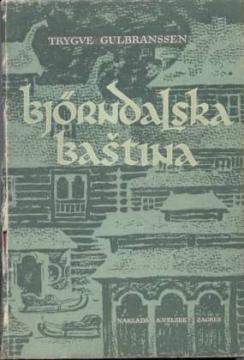
Björndalska baština: roman
Antique

Björndalska baština: roman

Trygve Gulbranssen

The novel follows the Björndal family, a close-knit clan living in the harsh Norwegian mountains. Through conflict, love, revenge and the fight for honor, it depicts their pride, tradition and the difficult journey towards reconciliation with their pasts.

The Björndal Legacy by Trygve Gulbranssen is the first part of a trilogy that depicts the life of the powerful but closed Björndal family, rooted in the wilderness of the Norwegian mountains. The novel is shaped as a family saga in which the fates of several generations are intertwined with the cruelty of nature, the old laws of honorable behavior and the pride that is passed down as an inheritance.

The center of the story is the patriarch Tore Björndal and his son Dag. Tore is a tough, unyielding man who enjoys an almost mythical reputation throughout the region. His strength inspires admiration, but also fear, and his past hides a whole series of conflicts and tragedies. Dag, the heir to the Björndal house, wants to forge his own path, but at the same time carries the burden of his father's deeds and the expectations of his environment. His path to maturity is marked by the struggle between his personal desire for tenderness and his inherited sense of duty.

The story also depicts Björndal's confrontation with the world around him — neighboring families, village dignitaries and social changes that threaten old customs. Tensions build through love affairs, misunderstandings, difficult decisions, and deadly conflicts where honor is more important than safety.

The novel highlights the contrast between the wild but honorable nature of the Björndal family and the hypocritical, sometimes cruel society of the valley. Through powerful psychological portraits and descriptions of the nature that shapes people, Gulbranssen creates a picture of a family that survives thanks to pride, loyalty, and an inexorable will to survive.

Original title
Der Blaser fra Dauningfjel / Ingen vei gar Utenom
Translation
Ivan Esih
Dimensions
20 x 14 cm
Pages
362
Publisher
Nakladni zavod Ante Velzek, Zagreb, 1944.
 
Latin alphabet. Hardcover.
Language: Croatian.

One copy is available

Condition:Used, good condition (visible signs of use)
Damages or inconvenience notice:
  • Damaged back
 

Are you interested in another book? You can search the offer using our search engine or browse books by category.

You may also be interested in these titles

Rudnik čvaraka

Rudnik čvaraka

Tomislav Šovagović

The debut work of Croatian writer Tomislav Šovagović, awarded the Josip and Ivan Kozarac Award in 2012, is a dedication to Slavonia – the region of his childhood that the author, born in Dalmatia, observes with foreign but tender eyes.

Mozaik knjiga, 20112.
Croatian. Latin alphabet. Paperback.
11.56
Andrićeva lestvica užasa

Andrićeva lestvica užasa

Svetislav Basara

A Serbian writer known for his satirical novels, Andrić's Ladder of Horrors dissects the Balkan mentality through a parable of Yugo-nostalgia and national myths. The title alludes to Ivo Andrić as a litmus test for criticism – Balkans claim him or reject

24 sata, 2021.
Serbian. Latin alphabet. Paperback.
11.56
Ljubičice u srijedu

Ljubičice u srijedu

Andre Maurois

André Maurois, a French writer known for his psychological novels and biographies, explores themes of family relationships, love, and internal conflicts in this work, which is characteristic of his style.

Svjetlost, 1965.
Croatian. Latin alphabet. Paperback.
3.42 - 3.62
Štefica Cvek u raljama života

Štefica Cvek u raljama života

Dubravka Ugrešić

Do you like "lovelies"? Whatever you think about them, you'll enjoy this superb pastiche of trivial romance novels.

Mladinska knjiga, 1990.
Croatian. Latin alphabet. Hardcover with dust jacket.
4.94
Zagrepčanka

Zagrepčanka

Branislav Glumac

Branislav Glumac published a novel without periods or commas in 1974, as the relentless stream of thought of a young rebel. Published in socialist Yugoslavia, the work caused a scandal with its openness and became a classic about generational rebellion.

IROS, 1986.
Croatian. Latin alphabet. Hardcover.
8.24
V.

V.

Thomas Pynchon

The novel represents a journey into an alternative world – a world that we all belong to from time to time, but of which we would not want to be a part, a world of paranoia and alienation that we are not entirely sure is just an alternative or the bare tr

Čarobna knjiga, 2010.
Serbian. Latin alphabet. Paperback.
21.98