Ulica mačka ribara
Antique
Rare book

Ulica mačka ribara

Jolán Földes

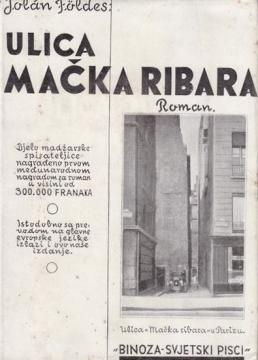
The novel tells about the difficult life of a working-class family of Hungarian emigrants in Paris after the First World War. In 1936, he won the All Nations Prize for a novel by Pinter Publishing Ltd (London). Rarely offered with cover.

The action of the novel Fisherman's Cat Street takes place in the narrowest street in Paris (Rue du Chat-qui-Pêche) where Hungarian immigrants live. Although at first it seems like a typical story about a small community, the novel explores deep themes such as identity, social injustice and family dynamics.

The novel follows the life of Julie, who tries to break free from tradition and patriarchal frameworks, and at the same time has to face the emotional and social obstacles that arise in her family environment. Her path to freedom is not easy. Conflicts with her mother and her father's despair break through the emotional and psychological layers of the main character.

The novel Ulica Mačka Ribara is a poignant and deeply emotional depiction of family, social and psychological problems, as well as the internal conflict between tradition and modernism. Through the life of the main character Julie, the author explores the individual's striving for freedom and independence, while facing emotional and social pressures. Ulica Macka Ribara is not only a story about one family, but also a story about universal themes such as social isolation, love, tradition and the struggle for identity.

Original title
A halászó macska uccája
Translation
Paula Rendi
Dimensions
20 x 14 cm
Pages
236
Publisher
Naklada Binoza, Zagreb, 1937.
 
Latin alphabet. Hardcover with dust jacket.
Language: Croatian.

One copy is available

The cover is compact, but the inside has been upgraded and taped, because the back flap is missing.
Condition:Used, very good condition
Damages or inconvenience notice:
  • Damaged book cover
 

Are you interested in another book? You can search the offer using our search engine or browse books by category.

You may also be interested in these titles

Crveni krin

Crveni krin

Anatole France

The Red Lily (1894) is not just a story of forbidden passion – it is a subtle, ironic fresco of a world in which love, politics, and art intertwine in a thin, almost transparent web of conventions and desires.

Svjetlost, 1961.
Serbian. Latin alphabet. Hardcover.
2.34 - 4.26
Konformist

Konformist

Alberto Moravia

Marcello Clerici, obsessed with normality after a traumatic childhood and a homosexual attack, becomes a fascist bureaucrat. He marries the average Giulia, and on their "honeymoon" in Paris, he is assigned to kill a former professor, anti-fascist Quadri.

Otokar Keršovani, 1966.
Croatian. Latin alphabet. Paperback.
4.96
Automat

Automat

Alberto Moravia

A collection of 41 short stories: the characters act like "automatons" – mechanical, listless, incapable of authentic reaction to life's problems. Modern man alienated, trapped in routine, sex, money and passivity, without will or feelings.

Otokar Keršovani, 1966.
Croatian. Latin alphabet. Hardcover.
3.22 - 3.96
Žena koja je slikala kanom

Žena koja je slikala kanom

Alka Joshi

"The Woman Who Painted with Henna" is the debut novel of Indian-American author Alka Joshi, the first part of the Jaipur trilogy. The novel has been praised for its authentic portrayal of Rajasthani culture and the universal theme of female emancipation.

Mozaik knjiga, 2021.
Croatian. Latin alphabet. Paperback.
13.2211.90
Baselska zvona

Baselska zvona

Louis Aragon

The novel follows three women: Diane, a noblewoman; Catherine Simonidzé, a feminist; and the real Clara Zetkin, a communist. Through their destinies, the crisis of bourgeois society, women's emancipation, and the path to communism are depicted.

Kultura, 1946.
Serbian. Latin alphabet. Hardcover.
5.76
Fabian: Pripovijest o moralistu

Fabian: Pripovijest o moralistu

Erich Kästner

Jakob Fabian, an unemployed Germanist and moralist, wanders through Berlin in the 1930s, observing the moral, political and social decay and the rise of Nazism. He falls in love with Cornelia, but tragedies and nonsense lead him to a tragic end. Criticism

Mladost, 1952.
Croatian. Latin alphabet. Paperback.
5.32