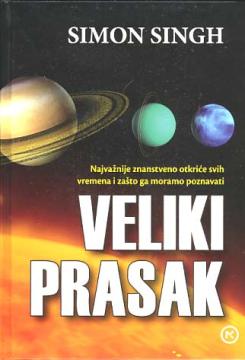
Veliki prasak: najvažnije znanstveno otkriće svih vremena i zašto ga moramo poznavati

Veliki prasak: najvažnije znanstveno otkriće svih vremena i zašto ga moramo poznavati

Simon Singh

Simon Singh, author of Fermat's Last Theorem and The Book of Ciphers, presents us with nothing less than the story of the Big Bang. The book in an excellent translation by Predrag Raos.

Albert Einstein once said, "The most incomprehensible thing about the cosmos is that it is comprehensible." Simon Singh believes that geniuses like Einstein are not the only ones who can understand the physics that describes our universe. We all can. In addition to explaining what the Big Bang theory actually is, this book also reveals why cosmologists believe that it provides an accurate description of the origin of the universe. Also, the book contains stories about brilliant and eccentric scientists who fought against the prevailing idea of ​​an eternal unchanging cosmos.

Simon Singh, known for clearly presenting ideas that otherwise seem difficult to understand, is the ideal guide on this journey through the cosmos. Everyone has heard of the Big Bang Theory, but who among us can claim to understand this theory? In his usual clear style and narration peppered with anecdotes and personal stories of those who have tried to understand the origin of the world, Simon Singh has written a book about the most important theory of all time.

Original title
Big Bang
Translation
Predrag Raos
Editor
Davor Uskoković
Graphics design
Ivica Jandrijević
Dimensions
24 x 17 cm
Pages
491
Publisher
Mozaik knjiga, Zagreb, 2007.
 
Latin alphabet. Hardcover.
Language: Croatian.
ISBN
978-9-53140-166-1

No copies available

The last copy was sold recently.
 

Are you interested in another book? You can search the offer using our search engine or browse books by category.

You may also be interested in these titles

Sunce: biografija

Sunce: biografija

David Whitehouse

David Whitehouse, a British astronomer and journalist, creates a living "biography" of our star in the book "The Sun: A Biography," combining history, myth, and science in a journey from the birth of the Sun to its final extinction.

Naklada Ljevak, 2007.
Croatian. Latin alphabet. Paperback.
9.78
Bošković – kalendar Hrvatskog prirodoslovnog društva

Bošković – kalendar Hrvatskog prirodoslovnog društva

Calendar dedicated to Ruđer Josip Bošković on the occasion of the 200th anniversary of his birth. Published in 1919 in Zagreb, the calendar provides an overview of Bošković's life and work, emphasizing his role in mathematics, astronomy, physics and philo

Hrvatsko prirodoslovno društvo, 1919.
Croatian. Latin alphabet. Paperback.
7.46
Lovci na zlato našeg stoljeća

Lovci na zlato našeg stoljeća

Harald Steinert

Gold Hunters of Our Century is a non-fiction book published in 1959 that explores the global race for rare and strategic minerals in the context of Cold War geopolitical dynamics.

Novinarsko izdavačko poduzeće, 1959.
Croatian. Latin alphabet. Hardcover with dust jacket.
7.24
Der klinische Blick

Der klinische Blick

Erwin Risak

"Der Klinische Blick" is a classic work that emphasizes the importance of clinical observation in diagnosis. Risak, a professor of medicine from Vienna, focuses on the systematic analysis of objective clinical signs that a doctor can perceive using his fi

Springer Verlag, 1942.
German. Latin alphabet. Hardcover with dust jacket.
16.54
Od Pola do Malnara: Putnici i istraživači u hrvatskoj kulturi od 13. do 20. stoljeća

Od Pola do Malnara: Putnici i istraživači u hrvatskoj kulturi od 13. do 20. stoljeća

Juraj Bubalo

The book by Zagreb travel writer and professor Juraj Bubalo is a kind of encyclopedia of Croatian travelers and explorers. Unique in Croatian non-fiction, it popularizes the culture of exploration and reminds us that Croats have been part of global discov

Meridijani, 2024.
Croatian. Latin alphabet. Hardcover.
28.32
Američki medijski blues

Američki medijski blues

Dario Topić

What exactly is television? How does it function in a promised land that uses it to produce its own history, and at a rapid pace, in the absence of a tradition of the European or any other ancient type?

Matica hrvatska, 1996.
Croatian. Latin alphabet. Paperback.
4.86