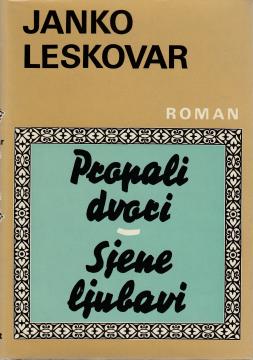
Propali dvori / Sjene ljubavi

Propali dvori / Sjene ljubavi

Janko Leskovar

"Propali dvori" is a novel by Janko Leskovar, published in 1896, which deals with deep psychological analyzes of the characters, emphasizing internal conflicts and feelings of disharmony with the outside world.

The action takes place in the surroundings of a ruined noble estate, which symbolizes decadence and the decay of former wealth. The main character, Fabijan Knezović, is a young man of humble origin, but highly educated and idealistic. Fabijan comes to the estate of the Kamiločević family, which is on the verge of financial ruin.

The family consists of the elderly Kamiločević, whose energy is spent, and his daughter Laura, a young but depressed woman, burdened by the burden of the family's past and social expectations. Fabijan falls in love with Laura, but that love is doomed in advance because of Laura's melancholy, which prevents her from finding happiness or a way out of her own psychological darkness.

Fabijan tries to help his family and restore the estate, believing in the power of work and will. However, faced with Laura's emotional coldness and his own growing doubts about the possibility of change, he eventually gives up on his attempts. Laura remains imprisoned in her suffering, and Fabijan leaves, deeply disappointed.

Dimensions
20 x 14 cm
Pages
263
Publisher
Mladost, Zagreb, 1978.
 
Latin alphabet. Hardcover with dust jacket.
Language: Croatian.

No copies available

The last copy was sold recently.
 

Are you interested in another book? You can search the offer using our search engine or browse books by category.

You may also be interested in these titles

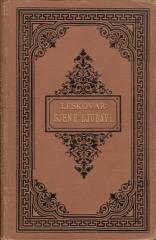
Sjene ljubavi

Sjene ljubavi

Janko Leskovar

A key novel of Croatian modernity. Leskovar depicts the overly sensitive writer Marcel Bušinski, who sinks in passive decadence into the shadows of unrealized, painful love, introspection, and mental weakness. First edition.

Štamparija Karla Albrechta (Jos. Wittasek), 1898.
Croatian. Latin alphabet. Hardcover.
23.56
Pažnja

Pažnja

Alberto Moravia

Francesco Merighi returns to Rome after 9 years abroad. In order to write an "authentic" novel, he keeps a diary of his life with his wife and their daughter Babe. He obsessively analyzes lies in relationships, the temptation of

Otokar Keršovani, 1966.
Croatian. Latin alphabet. Hardcover.
3.96
Kućni ljudi

Kućni ljudi

Almin Kaplan

In the novel Kućni ljudi (People of the House) by Almin Kaplan, the intimate stories of a Herzegovinian family depict everyday life, quiet anxiety, and changes in village life - a meeting of tradition, nostalgia, and contemporary stratification.

Buybook, 2022.
Croatian. Latin alphabet. Hardcover.
11.56
Dijalektika prijelaznog perioda

Dijalektika prijelaznog perioda

Viktor Pelevin

The book represents the author's anthology - the largest part is the novel Čisla (Čisla), followed by the short story Macedonian Criticism of French Thought and several short stories (Odin vog, Akiko, Fokus-grupa, Gost na prazniku bon).

Disput, 2006.
Croatian. Latin alphabet. Paperback.
9.68
Kuća na obali

Kuća na obali

Daphne Du Maurier

Du Maurier masterfully blends sci-fi, the gothic atmosphere of Cornwall, and psychological drama – about addiction, escape from reality, identity, and the value of nostalgia. A tense and introspective novel, with an emphasis on how the past can be more da

Nakladni zavod Matice hrvatske, 1977.
Croatian. Latin alphabet. Hardcover with dust jacket.
5.36
Liber memorabilium

Liber memorabilium

Ivan Lovrenović

Summarizing numerous sources with a strong authorial gesture, while retaining their own characteristics, Lovrenović composed a book documenting (a 'forbidden') history, not suspecting that he was writing an epitaph!

Durieux, 1994.
Croatian. Latin alphabet. Paperback.
7.94