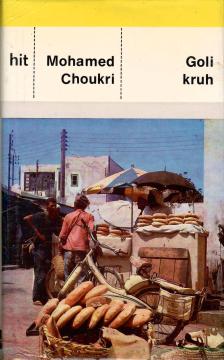
Goli kruh

Goli kruh

Mohamed Choukri

Mohamed Choukri's novel Bare Bread is a powerful autobiographical story about poverty, hunger and the struggle for dignity in Morocco in the mid-20th century.

The author, who comes from an extremely poor family, describes his childhood marked by violence, loss and poverty. Choukri faces cruel living conditions, loses family members and runs away from a tyrant father.

The work traces his transformation from an illiterate boy wandering the streets in search of food to a young man who finds salvation in education and literature. The brutal honesty and rawness of the language reflect the reality of marginalized sections of society, while the novel simultaneously celebrates human resilience and the aspiration for a better life.

Bare Bread is a universal story of survival and emancipation, becoming the voice of the disenfranchised and a symbol of the fight against social injustice.

Original title
Le pain nu
Translation
Dragutin Dumančić
Editor
Zlatko Crnković
Graphics design
Alfred Pal
Dimensions
19.5 x 12 cm
Pages
179
Publisher
Znanje, Zagreb, 1988.
 
Latin alphabet. Hardcover with dust jacket.
Language: Croatian.

One copy is available

Condition:Used, excellent condition
 

Are you interested in another book? You can search the offer using our search engine or browse books by category.

You may also be interested in these titles

Put oko svijeta u osamdeset dana

Put oko svijeta u osamdeset dana

Jules Verne

The novel Around the World in Eighty Days by Jules Verne is one of the most famous adventure works in world literature. The book celebrates exploration, knowledge, and the human ability to transcend boundaries.

Mladost, 1961.
Croatian. Latin alphabet. Paperback with dust jacket.
6.74 - 7.22
Čiča Gorio

Čiča Gorio

Honore de Balzac

Uncle Goriot is the story of the old war profiteer Goriot and his daughters, who, after robbing him to the point of being naked, leave him to die in the solitude and misery of the Vaquer boarding house. It is a story that can be read today on several leve

Nolit, 1965.
Serbian. Latin alphabet. Hardcover.
3.75 - 3.98
Ženski orkestar

Ženski orkestar

Fania Fenelon

Fanie Fénelon's novel The Women's Orchestra is a memoir that describes her experience of surviving in a women's orchestra at the Auschwitz-Birkenau concentration camp during World War II.

Globus, 1985.
Croatian. Latin alphabet. Hardcover with dust jacket.
8.74
Robin Hood

Robin Hood

Alexandre Dumas

Dumas portrays Robin Hood not only as a bandit who helps the poor, but also as a heroic fighter for justice and a symbol of resistance to feudal injustice.

Epoha, 1966.
Croatian. Latin alphabet. Hardcover with dust jacket.
4.26 - 4.82
Stranac

Stranac

Albert Camus

The Stranger is the novel with which Camus achieved his first great success, influenced by Nietzsche's philosophy, Sartre's philosophy of existentialism, and, most of all, his philosophy of the absurd.

Globus, 2004.
Croatian. Latin alphabet. Hardcover with dust jacket.
6.38
Gospođa Bovary

Gospođa Bovary

Gustave Flaubert

The novel follows the life of Emma Bovary, a young woman trapped in the monotony of provincial life and her own romantic illusions. Flaubert criticizes romantic ideals and social hypocrisy, showing the tragic consequences of Emma's escape from reality.

Zora, 1960.
Croatian. Latin alphabet. Hardcover with dust jacket.
8.46