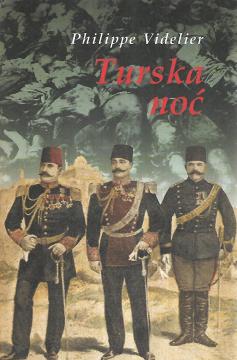
Turska noć

Turska noć

Philippe Videlier

The crime against the Armenians is only coming to light today. After almost a century, the tragedy of a nation, the indifference of the Constantinople authorities, the media cover-up and the turning of the international community's head are unfolding befo

French writer and historian Philippe Videlier tells the story of the crimes against the Armenian people, which took place in Turkey at the end of the 19th and the beginning of the 20th century. About one and a half million Armenians were executed in the genocide, the international community knew about the facts but did not react. Videlier's story, concise and sharp, is based on the sources he came across.

Philippe Videlier is an exceptional storyteller; what he found in the sources he narrated succinctly, sharply and excitingly. Therefore, his book, before the pocket edition, was published in the world's most famous literary library, Gallimard's "white series". And Annie Pilibossian wrote in the Le Figaro newspaper: "It is a poignant report, rich in testimonies from the time, about the fate of the Armenian people under the auspices of the Ottoman Empire from the end of the 19th and the beginning of the 20th century." An incredible lesson for future generations."

Original title
Nuit turque
Translation
Yves-Alexandre Tripković
Editor
Nenad Popović
Dimensions
21 x 14 cm
Pages
103
Publisher
Durieux, Zagreb, 2010.
 
Latin alphabet. Hardcover with dust jacket.
Language: Croatian.
ISBN
978-9-53188-313-9

One copy is available

Condition:Used, excellent condition
 

Are you interested in another book? You can search the offer using our search engine or browse books by category.

You may also be interested in these titles

Zaraćeno poraće: Konfliktni i konkurentski narativi o stradanju i iseljavanju Talijana Istre

Zaraćeno poraće: Konfliktni i konkurentski narativi o stradanju i iseljavanju Talijana Istre

Franko Dota

The book analyzes how conflicting historical narratives about the suffering and mass emigration of Italians from Istria and Rijeka developed in Croatia and Italy after World War II (1943–1956), debunking myths and encouraging an empathetic approach to the

Srednja Europa, 2010.
Croatian. Latin alphabet. Paperback.
11.32
Dizanje prošlosti u vazduh: Ogledi o Balkanu i Istočnoj Evropi

Dizanje prošlosti u vazduh: Ogledi o Balkanu i Istočnoj Evropi

Marija Todorova

A collection of essays by the Bulgarian historian Maria Todorova (known for Imaginary Balkans), compiled especially for the 20th Century Library. Indispensable for understanding post-communist transitions, culture of memory and Balkan studies.

Biblioteka XX vek, 2010.
Serbian. Latin alphabet. Paperback.
8.44
Komunisti Jugoslavije 1919-1979.

Komunisti Jugoslavije 1919-1979.

Pero Morača, Stanislav Stojanović

The book provides an overview of the history of the Communist Party of Yugoslavia (KPJ) from its founding to the late 1970s, emphasizing its role in the revolution, self-government, and construction of Yugoslavia, with an ideologically colored perspective

Eksportpres, 1979.
Serbian. Latin alphabet. Hardcover with dust jacket.
11.988.99
Na rubu revolucije - studenti '71.

Na rubu revolucije - studenti '71.

Tihomir Ponoš

This is the first book that comprehensively addresses the phenomenon of Croatian students and their role in the Croatian Spring. Students, along with the reform wing of the League of Communists and Matica Hrvatska, were one of the three pillars of the Cro

Profil International, 2007.
Croatian. Latin alphabet. Paperback.
9.56
Bitka za Moskvu

Bitka za Moskvu

Branko Kitanović

The Battle of Moscow is a historical account of the German Operation "Barbarossa", the Soviet defense and counteroffensive in 1941. The author, with the testimonies of the top Soviet military leaders, shows how the first German defeat in the war unfolded.

Alfa, 1975.
Croatian. Latin alphabet. Hardcover with dust jacket.
7.96
Nacionalni testament kralja Aleksandra I

Nacionalni testament kralja Aleksandra I

Branislav M. Stepanović

The author presents the political and ideological legacy of King Aleksandar I Karađorđević the Unifier. The book, published immediately after the king's death, is an attempt to preserve and transmit his political ideals to future generations.

Jugoslovenska biblioteka "Bratstvo", 1936.
Serbian. Cyrillic alphabet. Hardcover.
28.36