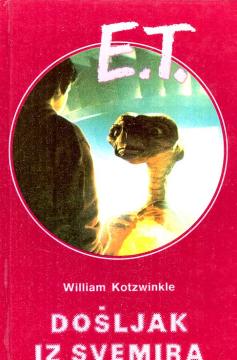
E.T. došljak iz Svemira

E.T. došljak iz Svemira

William Kotzwinkle

He is three million light years away from home, completely alone and in need of a friend...

The story takes place in the suburbs of Los Angeles in the early 1980s. A small alien E.T. (extraterrestrial) accidentally remains on Earth when his spaceship makes an emergency landing without him. E.T. is a botanist from a star in another galaxy, about a meter tall, with a long neck, a glowing finger and telepathy. Hungry and scared, he hides in the shed of the Elliott family - single mother Mary and her three children: Elliott (10), Michael (16) and Gertie (5). Elliott discovers E.T. and quickly becomes friends. The child and the alien connect telepathically - E.T. feels Elliott's emotions, and Elliott feels E.T.'s. Together they eat Reese's Pieces, E.T. learns English from the TV ("E.T. phone home!"), builds a communicator from household items (umbrella, record player, saw) to call his ship. E.T. displays miraculous powers: heals plants, levitates objects, and shares life energy. The government (NASA and uniformed agents) discovers E.T., seals off the house, and attempts to capture him. E.T. dies from the Earth's atmosphere, but Elliott and his friends (including the neighborhood boys) organize a bicycle escape—the iconic scene where the bicycles fly across the Moon. E.T. recovers, says goodbye to Elliott ("I'll be right here"—pointing to his heart) and returns home in a spaceship.

Original title
E.T. the Extra-Terrestrial
Translation
Mignon Mihaljević, Vlado Opačić
Editor
Jagoda Zelić Rukavina
Dimensions
19.5 x 13 cm
Pages
238
Publisher
Centar za informacije i publicitet (CIP), Zagreb, 1983.
 
Latin alphabet. Hardcover.
Language: Croatian.

Two copies are available

Copy number 1

Condition:Used, excellent condition
Damages or inconvenience notice:
  • Traces of patina

Copy number 2

Condition:Used, excellent condition
 

Are you interested in another book? You can search the offer using our search engine or browse books by category.

You may also be interested in these titles

Moj prijatelj gospodin Leakey

Moj prijatelj gospodin Leakey

J. B. S. Haldane

J. B. S. Haldane (1892–1964), a British geneticist, evolutionary biologist, and science popularizer, wrote "My Friend Mr. Leakey" in 1937 – a collection of five humorous, fantastic stories for children (and adults).

Novo pokoljenje, 1950.
Croatian. Latin alphabet. Hardcover.
7.54
Futura - Znanstvena fantastika & fantasy #49/1996

Futura - Znanstvena fantastika & fantasy #49/1996

Jack Williamson, Ester M. Friesner, Terry Bisson, Jack C. Haldeman, Jack Dunn, Zdravko Valjak, Kr...

Futura magazine was a Croatian magazine for speculative fiction, primarily for science fiction literature. The first issue of Futura was published in October 1992.

Bakal, 1996.
Croatian. Latin alphabet. Paperback.
3.28
Nije vreme za heroje

Nije vreme za heroje

Sam J. Lundwall

Today, Lundvall enjoys the reputation of the most famous Scandinavian master of science fiction.

Jugoslavija, 1980.
Serbian. Latin alphabet. Paperback.
2.98
Futura - Znanstvena fantastika & fantasy # 52 / 1997

Futura - Znanstvena fantastika & fantasy # 52 / 1997

Robert Silverberg, Gene Wolfe, John Kessel, Joe Haldeman, Darko Macan

Futura magazine was a Croatian magazine for speculative fiction, primarily for science fiction literature. The first issue of Futura was published in October 1992.

Bakal, 1997.
Croatian. Latin alphabet. Paperback.
3.36
Čovek naopako

Čovek naopako

Philippe Curval

The French writer Philippe Kirval is a well-known representative of the modern direction of science fiction in his country. The author of twelve novels, Kirval relatively early discovered the assumption of the existence of countless "parallel universes" a

Jugoslavija, 1978.
Serbian. Latin alphabet. Paperback.
2.98
Primicanje katastrofa: Propasti koje prijete našem svijetu

Primicanje katastrofa: Propasti koje prijete našem svijetu

Isaac Asimov

A popular science work in which Asimov, combining scientific rigor with a lucid style, explores possible threats to the survival of humanity, systematizing disasters according to their nature and probability.

August Cesarec, 1981.
Croatian. Latin alphabet. Hardcover with dust jacket.
7.46