Ljudska devolucija: Vedska alternativa Darwinovoj teoriji evolucije
Rare book

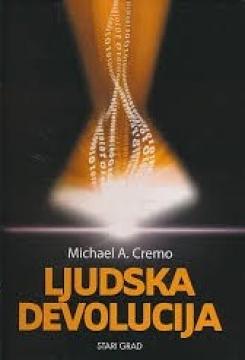
Ljudska devolucija: Vedska alternativa Darwinovoj teoriji evolucije

Michael A. Cremo

The book Human Devolution represents one of the boldest and most comprehensive attempts for modern science to confront its own limits and openly acknowledge the existence of evidence that does not fit into the official story of human origins.

Cremo, thoroughly and patiently, documents hundreds of archaeological finds from the 19th and early 20th centuries – human bones in layers tens and even hundreds of millions of years old, gold chains in coal 300 million years old, perfect human footprints in rocks from the dinosaur era, precisely crafted metal objects found deep in geological layers. Most of these finds were published in reputable scientific journals of the time (Nature, Scientific American, American Journal of Science), and the reports were signed by respectable geologists, paleontologists and mining engineers.

The author does not ask the reader to immediately accept Vedic cosmology, but only to be honest: if we accept that man is 100–200 thousand years old just because “anomalous” finds have been excluded from the literature, is this not a form of censorship of knowledge? Cremo proposes a bold but logical alternative: we did not evolve from matter – we “descended” into matter. Instead of "from ape to man", the process is reversed - from a pure spiritual being to ever denser forms of existence.

The book is extremely richly referenced (over 900 sources), written clearly and without aggression, and calls for an open dialogue between science and ancient wisdom. For many readers, it represents a true liberation of the intellect – a reminder that true science begins where dogma ends. Highly recommended to anyone who wants a bigger picture of who we are and where we come from.

Original title
Human Devolution: A Vedic Alternative to Darwin’s Theory
Translation
Petra Štrok
Editor
Božica Cikuša, Zdravko Cikuša
Graphics design
Zlatko Bilandžija
Dimensions
24 x 17 cm
Pages
566
Publisher
Stari grad, Zagreb, 2007.
 
Latin alphabet. Hardcover.
Language: Croatian.
ISBN
978-9-53671-652-4

One copy is available

Condition:New
 

Are you interested in another book? You can search the offer using our search engine or browse books by category.

You may also be interested in these titles

Orlov dar

Orlov dar

Carlos Castaneda

The Eagle's Gift is not just a shamanic manual, but also a philosophical meditation on the nature of reality, death, and the possibility of transcendence. Castaneda invites the reader to question their own beliefs about the world and open themselves to ne

August Cesarec, 1983.
Croatian. Latin alphabet. Hardcover with dust jacket.
13.34
Kultura i komunikacija: Logika povezivanja simbola

Kultura i komunikacija: Logika povezivanja simbola

Edmund Leach

In Culture and Communication, Edmund Leach explores social relations through language, rituals, and symbols. He connects anthropology with communication theory, showing culture as a system of meaning that shapes human behavior.

Biblioteka XX vek, 1983.
Serbian. Latin alphabet. Paperback.
7.32
Kratka povijest ljudske rase

Kratka povijest ljudske rase

Michael Cook

Michael A. Cook, Princeton professor of Islamic history, provides an overview of human history from the Neolithic to the fall of the Twin Towers in 2001 in this witty and intelligent synthesis, asking the key question: why did everything happen exactly th

Profil Knjiga, 2009.
Croatian. Latin alphabet. Paperback.
16.28
Rasprave o metodi

Rasprave o metodi

Ivan Kuvačić

"Discourses on Method" is a collection of essays and discussions by the prominent Croatian sociologist Ivan Kuvačić (1924–2005), written during his many years of work at the Department of Sociology at the Faculty of Philosophy in Zagreb.

Naprijed, 1988.
Croatian. Latin alphabet. Paperback.
6.74
Rajski brežuljci: Povijest moći i nemoći

Rajski brežuljci: Povijest moći i nemoći

Mineke Schipper

In her book, Mineke Schipper explores cultures throughout history to describe the complex relationship men have with the female body. Despite the symbiotic relationship between the sexes, men have always had greater power than women, and at the root of it

Durieux, 2021.
Croatian. Latin alphabet. Hardcover with dust jacket.
16.54