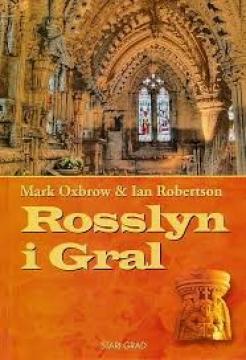
Rosslyn i Gral

Rosslyn i Gral

Mark Oxbrow, Ian Robertson

The book Rosslyn and the Grail by Scottish authors Mark Oxbrow and Ian Robertson is the most thorough and sobering work debunking the myths surrounding Rosslyn Chapel and its alleged connection to the Holy Grail and the Knights Templar.

The authors, a historian and archaeologist, systematically demystify claims from books such as The Holy Blood, The Holy Grail and The Da Vinci Code. They show that:

  • Rosslyn Chapel was not built in 1446–1486 for the Templars (the Order was abolished in 1312), but for the Sinclair family as a collegiate church;
  • there is no evidence that the Templars ever owned Rosslyn or the surrounding land;
  • the "secret symbols" (corn, aloe vera, three-dimensional cubes) are either later restorations (19th/20th centuries) or misinterpretations of ordinary biblical and Masonic motifs;
  • the alleged "cryptograms" and "coded messages" in the stone carvings do not exist when the original plans and photographs are examined.

The book features archival documents, old photographs before restoration and comparisons with similar Gothic churches. Although it shatters romantic myths, it does so with respect for the beauty of Rosslyn and leaves room for wonder at the skill of medieval stonemasons. The best "antidote" to sensationalist literature, and at the same time an excellent guide through the real history and architecture of one of Scotland's most beautiful chapels.

Original title
Rosslyn and the Grail
Translation
Vesna Valenčić
Editor
Božica Cikuša, Zdravko Cikuša
Graphics design
Zlatko Bilandžija
Dimensions
24 x 117 cm
Pages
232
Publisher
Stari grad, Zagreb, 2006.
 
Latin alphabet. Hardcover.
Language: Croatian.
ISBN
978-9-53671-647-0

Multiple copies are available

Copy number 1

Condition:New

Copy number 2

Condition:New

Copy number 3

Condition:New

Copy number 4

Condition:New

Copy number 5

Condition:New
 

Are you interested in another book? You can search the offer using our search engine or browse books by category.

You may also be interested in these titles

Važnost nalaza ranosrednjovjekovnog koplja u Varaždinu

Važnost nalaza ranosrednjovjekovnog koplja u Varaždinu

Željko Tomičić
Jugoslavenska akademija znanosti i umjetnosti, 1968.
Croatian. Latin alphabet. Paperback.
4.98
Hrvatski vladari 1-5.

Hrvatski vladari 1-5.

Neven Budak
Večernji list, 2012.
Croatian. Latin alphabet. Paperback.
The book consists of 5 volumes
12.34 - 15.32
Ilustrirana povijest svijeta: Rani srednji vijek (907.-1154.)

Ilustrirana povijest svijeta: Rani srednji vijek (907.-1154.)

Karin Feuerstein-Praßer, Andrea Groß-Schulte, Marion Jung, Cornelia Lawrenz, Karin Prager, Otto S...

The fourth volume of Reader's Digest's "Illustrated History of the World" series, illustrated in color, intended for history buffs, provides an overview of key events and civilizational achievements around the world, in the period from 907 to 1154.

Mozaik knjiga, 2010.
Croatian. Latin alphabet. Hardcover.
11.56
Povijest Europe - od seobe naroda do XVI stoljeća

Povijest Europe - od seobe naroda do XVI stoljeća

Henri Pirenne
Marjan tisak, 2005.
Croatian. Latin alphabet. Paperback.
6.96 - 6.98
Srednjevekovna umetnost u Srbiji i Makedoniji: Crkvena arhitektura i skulptura

Srednjevekovna umetnost u Srbiji i Makedoniji: Crkvena arhitektura i skulptura

Đurđe Bošković
Jugoslovenska knjiga, 1948.
Serbian. Cyrillic alphabet. Hardcover.
5.48
O kraljevstvu Dalmacije i Hrvatske

O kraljevstvu Dalmacije i Hrvatske

Ivan Lučić-Lucius

The life work of Ivan Lučić and the debut of Croatian historiography (first printed in 1666 in Amsterdam). The work appears for the first time in the form the author intended, with the author's corrections and additions as well as critical treatment of in

Biblioteka Latina & Graeca, 1986.
Croatian. Latin alphabet. Paperback.
18.24