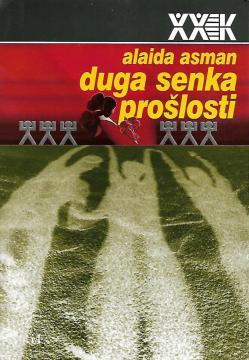
Duga senka prošlosti: kultura sećanja i politika povesti
Aleida Assmann, a leading theorist of the culture of memory (along with her husband Jan Assmann), explores in this seminal book how the past shapes the present through the tension between the culture of memory (Erinnerungskultur) and the politics of histo
The title "The Long Shadow of the Past" alludes to the fact that the 20th century (especially the Holocaust and totalitarianism) still casts a shadow on contemporary society – it does not disappear, but is constantly reinterpreted.
The book is divided into two main parts:
Theoretical foundations: Assmann distinguishes between individual, social and cultural memory. The concept of "collective memory" is not fixed – it moves from communicative (live, 3–4 generations, oral) to cultural (institutionalized: museums, monuments, archives, canon). He distinguishes between functional memory (active, identity-based, selective) and storage memory (passive, archival, potential). He criticizes the mythologizing of the past and shows how memory and history converge in the shadow of the Holocaust.
Political dimension: He analyzes how states and societies use the past – from national myths (Renan) to the politics of memory after 1989 (the fall of communism, dealing with the Holocaust in Germany). He discusses tensions: personal experience vs. official memory, trauma vs. triumph, forgetting as a strategy (e.g. new beginnings after the war) and the risks of revisionism.
Assmann emphasizes that memory is not only an ethical obligation, but a dynamic process – it can be constructive (reconciliation) or destructive (nationalism, victimization). The book is interdisciplinary: it combines cultural studies, history, psychology and political science, with examples from Europe (Germany, Eastern Europe, the Balkans implicitly).
This masterpiece of modern memory theory – clear, accessible and provocative – is indispensable for understanding how the past is used in identity politics today. In the Croatian/Serbian context, it is particularly relevant due to the wars of the 1990s and transitional debates on memory.
One copy is available