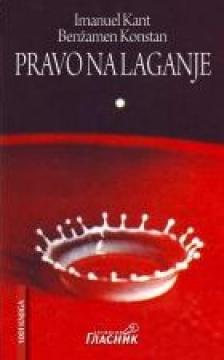
Pravo na laganje

Kant argued that there is no right to lie because telling the truth is an absolute duty, while Constant advocated the possibility of an exception to the duty, arguing that one should lie for the common good, which sparked a famous philosophical debate.
This 1797 discussion begins with Constant's critique of Kant in his essay Des réactions politiques: an absolute duty to tell the truth, if applied unconditionally, would destroy society. Constant gives an example: if a murderer asks about a friend who has hidden in your house, lying would be justified out of philanthropy – because the murderer has no right to the truth.
Kant responds strongly, defending the absolute prohibition of lying. Kant's key arguments:
- The expression "right to the truth" is meaningless – there is no objective right to the truth, but only a subjective duty of truthfulness (veracitas) towards oneself and others.
- A lie is a deliberate untruth in a statement to another – it does not depend on harm, but on the violation of a formal duty of reason.
- The duty to tell the truth is categorical, without exceptions – the basis of all contracts, trusts and rights. If an exception is allowed (e.g. out of love for one's neighbor), the maxim becomes non-universal: the world would collapse into a chaos of distrust.
- In Constant's example: if you lie to a murderer, you are violating your duty – even if you do not accidentally harm him, lying is a crime against reason. If the murderer forces you to make a statement, the lie is a falsiloquium (untruth), but still a violation – you are responsible for the consequences if the lie enables the crime.
Kant does not allow "white lies" out of humanity – truthfulness is a sacred commandment of reason, of unlimited benefit. Constant sees this as a rigidity that destroys society; Kant sees Constant's approach as opportunism that undermines the foundation of morality.
This debate – one of the most famous in ethics – shows the conflict between absolute deontologism and pragmatic consequentialism.
One copy is available