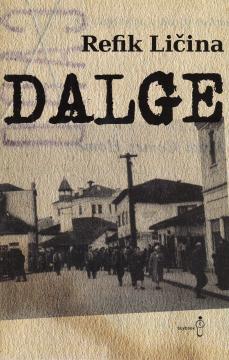
Dalge (priča na sklapanje)

Dalge (priča na sklapanje)

Refik Ličina

Dalge (a folding story) by Refik Ličina is a collection of short prose – a lyrically fragmented chronicle of Novi Pazar, the city where the author lived until 1992 before his exile to Sweden (Lund).

The title "dalge" (plural of the Turkish word "dalga" - wave, wave) symbolizes the waves of memories, emotions and everyday life that are refracted through fragments: street scenes, conversations, memories, smells, sounds and people - from Avda, street characters, to intimate moments and social changes.

The book is not a classic novel or a collection of stories, but a "story to assemble" - a mosaic of short texts, diary entries, reportage sketches and poetic miniatures. The author evokes Novi Pazar in the 80s and 90s: neighborhoods, mosques, cafes, shadows of war, exile longing and a subtle criticism of transition. The prose is simple, melancholic, rich in images and smells - a combination of the intimate and the social, the past and the present.

Ličina (born 1956, Radmanci, Montenegro) writes about identity, uprootedness, language and memory - the city becomes a universe of small destinies. The book is appreciated as a lyrical portrait of Sandžak and the exile experience, with a touch of humor and sadness. One of the key ones in his oeuvre of short prose (along with "Greenhouses", "Fear of Behar", "Fish in the Well").

Editor
Kristina Ljevak
Graphics design
Boris Stapić
Dimensions
21 x 13.5 cm
Pages
198
Publisher
Buybook, Sarajevo, 2018.
 
Latin alphabet. Paperback.
Language: Croatian.

One copy is available

Condition:Unused
 

Are you interested in another book? You can search the offer using our search engine or browse books by category.

You may also be interested in these titles

I drugi su pjevali o ratu: Odjeci raspada Jugoslavije u engleskoj i američkoj književnosti

I drugi su pjevali o ratu: Odjeci raspada Jugoslavije u engleskoj i američkoj književnosti

Muharem Bazdulj

In this book of essays, Muharem Bazdulj analyzes how the collapse of Yugoslavia and the wars of the 1990s resonated in Anglo-Saxon literature – from pre-war stereotypes to war and post-war depictions.

Biblioteka XX vek, 2013.
Croatian. Latin alphabet. Paperback.
8.24
Kako što nastaje: novine, film, teatar

Kako što nastaje: novine, film, teatar

Karel Čapek

In a witty and instructive essay, Čapek describes how a newspaper, a film, and a theater play are created. Through humor and irony, he shows the complexity of the process – from idea to realization – and the different perspectives of the participants, dem

Znanje, 1985.
Croatian. Latin alphabet. Paperback.
4.76
Bosna sjete i zaborava

Bosna sjete i zaborava

Enes Karić

Essays about the land of inexhaustible inspirations.

Durieux, 1997.
Croatian. Latin alphabet. Paperback.
5.32
Katastrofe

Katastrofe

Books and writers mark catastrophes on the map, catastrophes of the wars of the nineties, catastrophes of the Holocaust, catastrophes as words from the street and television, traffic that is a catastrophe, the price of carrots that is a catastrophe, catas

MeandarMedia, 2024.
Croatian. Latin alphabet. Paperback with dust jacket.
17.98
Objektivni korelativi: tuga - mržnja - radost

Objektivni korelativi: tuga - mržnja - radost

Dalibor Cvitan

A posthumous collection published on the occasion of the 25th anniversary of the death of Dalibor Cvitan (1934–1993), a prose writer, poet, essayist and critic. It contains a selection of around twenty essays, short stories and feuilletons - a cross-secti

Društvo hrvatskih književnika, 2018.
Croatian. Latin alphabet. Paperback.
6.32
Kad ste utopljeni u plamenu

Kad ste utopljeni u plamenu

David Sedaris

If it seems to you that beneath the surface of the sometimes monotonous everyday life lies a hilarious absurdity, David Sedaris will finally convince you of that.

Algoritam, 2010.
Croatian. Latin alphabet. Paperback.
3.98