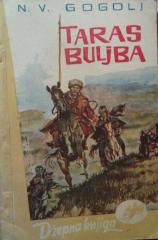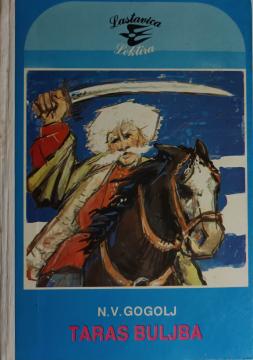
Taras Buljba

Taras Buljba

Nikolaj Vasiljevič Gogolj
Translation
Milovan Glišić
Editor
Amira Idrizbegović
Illustrations
Selimović Enis
Graphics design
Selimović Enis
Dimensions
20 x 14 cm
Pages
153
Publisher
Veselin Masleša, Sarajevo, 1985.
 
Distribution: 8,000 copies
 
Latin alphabet. Hardcover.
Language: Croatian.

Two copies are available

Copy number 1

Condition:Used, excellent condition
Damages or inconvenience notice:
  • Library stamp

Copy number 2

Condition:Used, very good condition
Damages or inconvenience notice:
  • Library stamp
 

Are you interested in another book? You can search the offer using our search engine or browse books by category.

You may also be interested in these titles

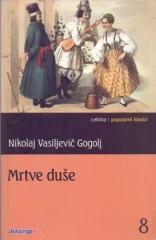
Mrtve duše

Mrtve duše

Nikolaj Vasiljevič Gogolj

Dead Souls (1842) is a brilliant satire that exposes the moral and social rot of imperial Russia through Chichikov's fraud with dead serfs, with Gogol's virtuoso mix of humor, irony and lyricism.

Jutarnji list, 2004.
Croatian. Latin alphabet. Paperback.
4.24 - 4.99
Taras Buljba

Taras Buljba

Nikolaj Vasiljevič Gogolj
Svjetlost, 1961.
Croatian. Latin alphabet. Paperback.
2.78 - 3.98
Maskerata

Maskerata

Mihail J. Ljermontov

Lermontov's Masquerade is a powerful romantic drama about jealousy, honor, deceit, and deadly suspicion, set in the elegant world of balls, intrigue, and social masks.

Zora, 1965.
Croatian. Latin alphabet. Hardcover with dust jacket.
5.34
Die Brüder Karamasow

Die Brüder Karamasow

Fjodor M. Dostojevski

The Brothers Karamazov is the last book by Russian writer Fyodor Mikhailovich Dostoevsky. Dostoevsky spent nearly two years writing The Brothers Karamazov, which was first published in serial form in the journal Russian Gazette, and was completed in late

Deutscher Bücherbund, 1976.
German. Latin alphabet. Hardcover with dust jacket.
8.54
The Idiot

The Idiot

Fjodor M. Dostojevski
Wordsworth, 1996.
English. Latin alphabet. Paperback.
8.32
Bijedni ljudi

Bijedni ljudi

Fjodor M. Dostojevski

Poor Folk is the first novel by Fyodor M. Dostoevsky. Through the letters of the poor clerk Makar Devushkin and Varvara Dobroselova, it depicts the lives of people on the margins of society, their loneliness, poverty, and struggle to preserve their dignit

Narodna knjižnica, 1919.
Croatian. Latin alphabet. Paperback.
5.24