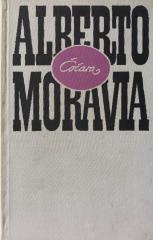
Čočara
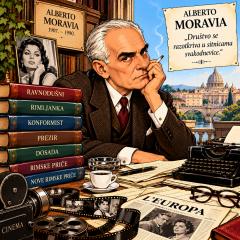
Widow Cesira and her daughter Rosetta flee bombed Rome to their native Ciociaria, where they experience hunger, fear and misery. Liberation brings tragedy: Rosetta is raped by Moroccan soldiers, destroying their faith in God and people.
The Maid is one of Alberto Moravia's most powerful war novels, published in 1957, based in part on his own experiences fleeing Rome in 1943–1944 with Elsa Morante. The story is told in the first person from the perspective of Cesira, a strong, pragmatic widow from Ciociaria (a region south of Rome, known for its poverty and peasant roots), who runs a small shop in Rome to survive.
Cesira wants to protect her 18-year-old daughter Rosetta, a beautiful, pious and naive girl. As the war approaches Rome (Allied bombing, German occupation), Cesira sews money into a dress and flees with her daughter to the countryside, to her native village of Vallecorsa. There they encounter hunger, cold, peasant selfishness and the chaos of war. They meet Michele, an idealistic anti-fascist who tries to awaken the peasants, but to no avail. They spend nine months in the mountains, hiding, starving, and waiting for the Allies.
The liberation in 1944 brings the greatest tragedy: on the way back to Rome, Rosetta is brutally raped by a group of Moroccan goumiers (Allied soldiers in the French army) – a real historical event known as the marocchinate. The act destroys Rosetta's innocence and faith; she sinks into despair, becomes promiscuous, and becomes a prostitute. Cesira loses faith in people and God, realizing that evil is not only in fascism or war, but in human nature itself – including her own. The novel ends without hope: they have survived, but broken.
Here Moravia abandons the bourgeois introspection of her earlier works and enters a neorealist depiction of war from a female perspective – hunger, humiliation, violence against women, peasant opportunism, and the lie of "liberation." She criticizes how war exposes the worst in people, regardless of side. The work is strongly autobiographical and politically engaged, with a focus on physicality and moral breakdown.
The novel was adapted into a famous film by Vittorio De Sica in 1960 with Sophia Loren (Oscar for Best Actress) and Jean-Paul Belmond – the film enhanced the emotional and visual impact of the story. Čočara remains a poignant portrait of war as a destroyer of humanity, especially women's destiny in chaos.
One copy is available