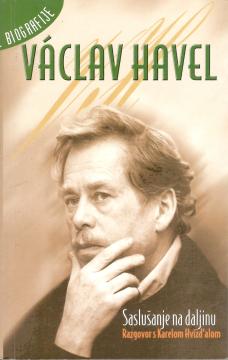
Saslušanje na daljinu: Razgovor s Karelom Hvížďalom
Havel speaks honestly and deeply about his life, his literary journey, his dissident struggle, and his moral responsibility in a totalitarian regime. An intimate autobiographical confession of a dissident facing the "remote interrogation" of the free worl
The book "Distance Interrogation: A Conversation with Karel Hvížďal" (1986) is one of Havel's most important and personal texts from the period of normalization in Czechoslovakia. It was written at a time when Havel, after many years of imprisonment (1979–1983), was under constant pressure from the StB, banned and marginalized – a "mercenary of imperialism" for the regime, and a symbol of resistance for the West and part of the domestic public.
The conversation with the exiled Czech journalist Karel Hvížďal (who sent questions through secret channels, and Havel answered in handwritten texts) took place in 1985–1986, on the eve of Havel's 50th birthday. The title "Distance Interrogation" ironically alludes to the fact that it is a kind of "interrogation" without the presence of the prosecutor – Havel himself faces questions about his life, but freely, without censorship and fear of the police.
Havel describes his childhood in a wealthy Prague family, his literary beginnings in the 1950s (poetry, essays, theater), his experience of the "thaw" in the 1960s, the Prague Spring and its collapse in 1968, his entry into the dissident circle, the signing of Charter 77 and the consequences: loss of job, ban on publishing, imprisonment. He speaks particularly forcefully about the prison experience - humiliation, work in a uranium mine, psychological pressure, but also about how prison became a place of inner freedom and moral purity.
The book is not just a biography; Havel reflects on key themes of his life and thought: about "living in truth" versus the lies of a totalitarian system, about the responsibility of an intellectual, about the meaning of non-violent resistance, about the absurdity of the regime and about the hope for change. The style is honest, introspective, sometimes humorous and self-ironic - Havel does not glorify himself, but shows his weaknesses, doubts and fears.
This book became an international bestseller, helping to spread Havel's voice around the world and contributing to his reputation as a moral authority. Today it is read as a key document of dissident thought in the 1980s – a testament to how the individual can preserve dignity and truth in a system that does everything to destroy them. It is Havel's "remote monologue" that, paradoxically, became one of the most powerful voices against totalitarianism, and later the foundation of his political philosophy as president.
One copy is available