Osvajači
Antique

Osvajači

Andre Malraux

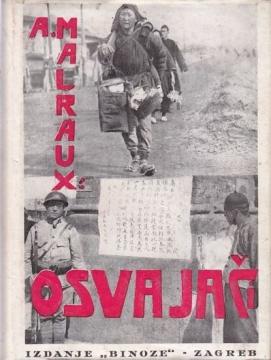
"The Conquerors" by Andre Malraux is a novel about revolutionaries, idealists, and adventurers in China in the 1920s, where the relationship between ideals, power, and human destiny is explored through political struggle, conflicts, and personal motives.

Les Conquérants (1928) is one of Malraux’s key early novels, set during the revolutionary upheavals in southern China after World War I. The plot follows a group of revolutionaries, Western intellectuals, labor leaders, and political adventurers as they navigate this turbulent space marked by imperial influences, local dictatorships, and the birth of modern Chinese communism. The main characters include Garine, an energetic and charismatic revolutionary, and Clappique, an eccentric and somewhat grotesque adventurer whose character brings irony and distance to the dramatic events.

The novel depicts revolutionary fervor, but also its internal ambivalence: the struggle for the ideal of liberation is intertwined with personal ambitions, moral hesitations, and the often brutal reality of political action. Malraux focuses strongly on the psychology of revolutionaries—their need to act, their sense of a destiny, and the tension between ideals and necessary compromises. In the background is the image of a colonially divided China, the city of Canton and the wider area where different ideologies, cultures and historical forces collide.

Stylistically, Malraux builds a dense, almost reportage atmosphere, with rapid changes of scenes, strong visual descriptions and interior monologues that bring existential anxiety and the search for meaning. "The Conquerors" is thus a novel about revolution, but also about a man who, in the vortex of history, tries to grasp a lasting value - freedom, action, or at least the belief that his struggle has meaning. The work combines political drama, existentialism and an adventurous tone, making it one of the fundamental texts of early Malraux.

Original title
Les Conquérants
Translation
Ante Bonifačić
Dimensions
20 x 14 cm
Pages
210
Publisher
Naklada Binoza, Zagreb, 1932.
 
Latin alphabet. Hardcover with dust jacket.
Language: Croatian.

Two copies are available

Copy number 1

Condition:Used, very good condition
Damages or inconvenience notice:
  • The cover is missing

Copy number 2

Condition:Used, very good condition
Damages or inconvenience notice:
  • The cover is missing
Discounted price: 5.424.06
25% discount is valid until 6/19/26 11:59 pm
 

Are you interested in another book? You can search the offer using our search engine or browse books by category.

You may also be interested in these titles

Oluja u Šangaju

Oluja u Šangaju

Andre Malraux
Zora, 1956.
Croatian. Latin alphabet. Hardcover.
4.99
Etika i akcija

Etika i akcija

Sonja Popović Zadrović, Andre Malraux
Mladost, 1978.
Croatian. Latin alphabet. Paperback.
2.99
Nada

Nada

Andre Malraux
Sveučilišna naklada Liber (SNL), 1977.
Croatian. Latin alphabet. Hardcover with dust jacket.
5.48 - 5.52
Sanjaj nemogući san

Sanjaj nemogući san

Johannes Mario Simmel

From the bestselling author of "Jimmy and the Rainbow," comes a novel that weaves a love story with the stirring events of the Bosnian war. This story, woven into the historical context, reminds us that sometimes the impossible dream is the only one worth

Mozaik knjiga, 1997.
Croatian. Latin alphabet. Hardcover.
7.42
Zaboravljene djevojke

Zaboravljene djevojke

Martha Hall Kelly

The novel The Forgotten Girl is based on the real life of a member of New York's posh circles, who fought for the rights of Kunić, a group of women who survived the horrors of the Ravensbrück concentration camp.

Mozaik knjiga, 2018.
Croatian. Latin alphabet. Paperback.
7.98 - 8.42
Dunav: P.S. 1991. vukovarske razglednice

Dunav: P.S. 1991. vukovarske razglednice

Pavao Pavličić

A moving and poignant chronicle of the siege and destruction of Vukovar in 1991 through 57 short "postcard" chapters. Pavličić does not write from the perspective of an "ordinary" Zagreb resident who spent the summer of 1991 in Vukovar, and then followed

Hena Com, 1999.
Croatian. Latin alphabet. Hardcover.
11.26