Svjetska knjižnica, Sv. 3.
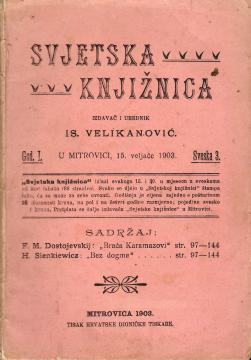
The World Library, Volume 3, edited and published by Iso Velikanović, contains excerpts from The Brothers Karamazov by F. M. Dostoevsky and Without Dogma by H. Sienkiewicz. Designed for self-binding of individual works.
The World Library was one of the most important editions of translations of world literature into Croatian at the beginning of the 20th century. The publisher and editor-in-chief was Iso Velikanović (1869–1940), a prolific translator, writer and cultural activist. The first volumes were published in 1903 in Sremska Mitrovica.
Volume 3 from 1903 is characteristic for the concept of the edition: each work (i.e. a larger excerpt) was printed so that it could be bound independently as a separate booklet. This volume published translations on pages 97–144:
- Fyodor Mikhailovich Dostoevsky – excerpt from the novel The Brothers Karamazov
- Henryk Sienkiewicz – excerpt from the novel Without Dogma (Bez dogmatu)
This method of publishing allowed readers to collect entire novels or larger units from different volumes over time and bind them into separate books. This was a practical and economical method of popularizing world literature among the Croatian audience.
The World Library had great cultural significance because at a time when Croatian literature was still searching for its place in the Austro-Hungarian context, it brought contemporary European and Russian authors (Dostoevsky, Tolstoy, Sienkiewicz, Ibsen, etc.) in quality translations. Velikanović's translation work is considered pioneering in introducing Russian literature into Croatian culture.
The edition was published in a smaller format, at an affordable price, intended for a wider audience – teachers, students, citizens and intellectuals. It represented an important step in the democratization of high literature and the enrichment of the Croatian literary language.
Today, copies of the World Library are a bibliographical rarity, especially the early volumes from 1903. They testify to the enthusiasm of the Croatian intelligentsia at the beginning of the 20th century to follow European literary trends despite political and material difficulties.
One copy is available
- Slight damage to the cover