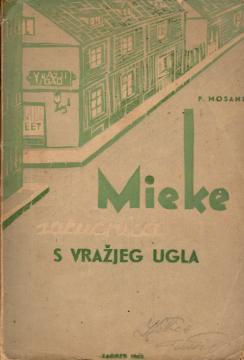
Mieke: zaručnica s "Vražjeg ugla"
Rare book
Antique

Mieke: zaručnica s "Vražjeg ugla"

Philipe Mosane

A Catholic story about the life, conversion, illness and Christian sacrifice of a young worker, Mieke, from a poor and sinful suburb, intended primarily for young girls and workers.

The book belongs to the genre of Catholic educational and biographical-devotional prose, very popular in the interwar and war periods. The plot follows the life of a young girl named Mieke from a poor, morally “fallen” suburb called “Devil’s Corner” (Coin du Diable).

Mieke lives in difficult social conditions, surrounded by poverty, sins and worldly temptations. The novel describes her gradual conversion, encounter with the Catholic faith (especially through the Catholic women’s workers movement – ​​JOC – Jeunesse Ouvrière Chrétienne), deep piety, engagement with Christ and finally accepting a serious illness as a cross and a sacrifice.

The work emphasizes the themes of conversion, purity, sacrifice, suffering and the sanctification of everyday life – typical of Catholic spiritual literature of the time. Mieke becomes a model of a Christian worker who remains faithful to God and the Church in the midst of difficult circumstances. The book is written in a simple, emotional style, with the aim of inspiring and spiritually building readers, especially those from working-class backgrounds.

In Croatia, the edition was published in the midst of World War II and NDH, at a time when Catholic organizations (Crusaders, Catholic Action) were very active in promoting religious and moral revival. A review of the book was published in the magazine Obnovljeni Život in 1942.

Today, the book is a bibliographical rarity and represents an interesting example of popular Catholic literature of the 20th century that combines social themes with piety and the ideal of holy everyday life.

Original title
Mieke, la fiancée du "Coin du Diable"
Translation
Stjepan Bäuerlein
Dimensions
22 x 15 cm
Pages
103
Publisher
Veliko križarsko bratstvo i veliko križarsko sestrinstvo, Zagreb, 1942.
 
Latin alphabet. Paperback.
Language: Croatian.

One copy is available

Condition:Used, excellent condition
 

Are you interested in another book? You can search the offer using our search engine or browse books by category.

You may also be interested in these titles

Bračna abeceda

Bračna abeceda

Christa Meves

Short, practical, and full of optimism, The Marriage Alphabet remains a favorite among couples, engaged couples, and pastoral workers—an ideal gift for a wedding or vow renewal. It's easy to read, yet leaves a deep impression.

Karitativni fond UPT, 1986.
Croatian. Latin alphabet. Paperback.
3.46
Poslanje žene: Putovi i zadaci feminizma

Poslanje žene: Putovi i zadaci feminizma

Paul Tournier

Paul Tournier's book The Mission of Woman presents the Swiss physician, theologian, and pioneer of "personal medicine"'s reflections on the role and mission of women in the contemporary world, from a Christian and psychological perspective.

Provincijalat franjevaca trećoredaca, 1991.
Croatian. Latin alphabet. Paperback.
5.74
Plamen za visinama: Misli Sluge Božjega Ivana Merza

Plamen za visinama: Misli Sluge Božjega Ivana Merza

Ivan Merz

"The Flame for the Heights" is a collection of spiritual thoughts, writings, and meditations by Croatian Catholic layman Ivan Merz (1896–1928), a prominent figure in the Croatian Catholic movement and later a blessed figure of the Catholic Church.

Filozofsko-teološki institut Družbe Isusove, 1999.
Croatian. Latin alphabet. Paperback.
5.00
YOUCAT - Katekizam za mlade

YOUCAT - Katekizam za mlade

YOUCAT (Youth Catechism) is the first Catholic catechism for young people valid for the entire Church. This unique religious manual, written in the language of young people, has original and attractive content, with many color photos and very attractive g

Verbum, 2022.
Croatian. Latin alphabet. Hardcover.
12.32
Što je Opus Dei? Priče o Bogu, krvi, novcu i vjeri

Što je Opus Dei? Priče o Bogu, krvi, novcu i vjeri

Noam Friedlander

The Catholic movement Opus Dei, founded in 1928 in Spain as a small devout group, is today one of the most influential and richest church organizations in the world – with millions of members, a headquarters in New York worth billions, and branches across

Naklada Ljevak, 2005.
Croatian. Latin alphabet. Hardcover.
13.26